
Commonwealth Kabaddi Championship 2026: Where to Watch in India and What Happened
मुख्य उत्तर: कॉमनवेल्थ कबड्डी चैंपियनशिप 2026, 23–31 अक्टूबर 2026 को अहमदाबाद में पूरी हुई। भारत में प्रसारण Star Sports और JioHotstar पर तय था; अब लाइव मैच उपलब्ध नहीं हैं। मुख्य तथ्य: - पुरुष फाइनल: भारत ने श्रीलंका को 54–20 से हराया। - महिला फाइनल: भारत ने युगांडा को 35–15 से हराया। - टूर्नामेंट में पुरुषों की 13 और महिलाओं की 10 टीमों ने भाग लिया। - आयोजन Veer Savarkar Sports Complex, Ahmedabad में हुआ। स्रोत: International Kabaddi Federation, आयोजन सूचना, 2026; Pro Kabaddi, आयोजन और फाइनल रिपोर्ट, 31 अक्टूबर 2026। ([ikfkabaddi.org](https://www.ikfkabaddi.org/news-detail-commonwealth.html)) संबंधित प्रश्न: प्रश्न: क्या टूर्नामेंट अभी लाइव देखा जा सकता है? उत्तर: नहीं, मुकाबले 31 अक्टूबर 2026 को समाप्त हो गए। प्रश्न: पुरुष फाइनल किसने जीता? उत्तर: भारत ने श्रीलंका को 54–20 से हराया। प्रश्न: क्या कबड्डी 2030 Commonwealth Games में शामिल है? उत्तर: उपलब्ध जानकारी इसे शामिल खेल नहीं बताती; चैंपियनशिप को उस संभावना के समर्थन में आयोजित अलग आयोजन बताया गया है।
The live matches in Ahmedabad are over
The noise in the stands may have peaked on a single raid, but the story of this tournament cannot be read from that sound alone. Start with the stage the matches reached, who had a chance to watch, and the arrangements behind that stage. The Commonwealth Kabaddi Championship 2026 was played from October 23 to 31 and has now concluded. There is no live option now. In India, coverage was scheduled on Star Sports and JioHotstar. Official event information confirms those platforms, but does not guarantee that every match was available free of charge. (ikfkabaddi.org)
The practical options now are the official results and any video coverage that remains available. Naming a broadcast partner and confirming that every match is freely accessible are different things. The official announcement names Star Sports and JioHotstar. Pro Kabaddi’s tournament-time information said matches before 6 p.m. would stream only on JioHotstar, while later matches were also scheduled for Star Sports. The public announcements reviewed do not establish that every digital stream was available without a subscription or that an official free YouTube broadcast covered every match. Calling it a guaranteed free live stream would therefore be misleading. (ikfkabaddi.org)
There was another concrete option for spectators: entry to matches at the Veer Savarkar Sports Complex was free, but required prior online registration. Pro Kabaddi announced that arrangement before the event. It no longer applies to future spectators now that the tournament is over. For readers searching for a live broadcast, the dates matter: this is no longer a prospective viewing guide, but an updated account of the event’s coverage and results. (prokabaddi.com)
Nine days, two competitions, different pressures
The first Commonwealth Kabaddi Championship took place at the Veer Savarkar Sports Complex in Naranpura, Ahmedabad. Thirteen teams competed in the men’s event and 10 in the women’s. Before the tournament, the announced plan was for teams from 23 nations and more than 400 athletes to contest 62 matches: 39 men’s matches and 23 women’s matches. This was neither a franchise league season nor part of the Commonwealth Games themselves. It was a separate championship for Commonwealth nations. Organisers presented it as a platform to expand the sport’s international reach and make kabaddi’s case in the context of the Commonwealth Games scheduled for Ahmedabad in 2030. Its purpose had two sides: titles on the mat, and an effort beyond it to introduce the sport to a wider audience. (prokabaddi.com)
The competition began with a group format. The 13 men’s teams were divided into groups of seven and six; the 10 women’s teams were also split into two groups. The semi-finals were held on October 30, followed by the gold-medal matches on October 31. That schedule demanded repeated matches over nine days. Alongside the quality of a team’s starting seven, bench use, recovery and match-to-match rhythm become important in a packed programme. A results list is not enough: it is worth asking how a team sustained its level through the pressure days. (prokabaddi.com)
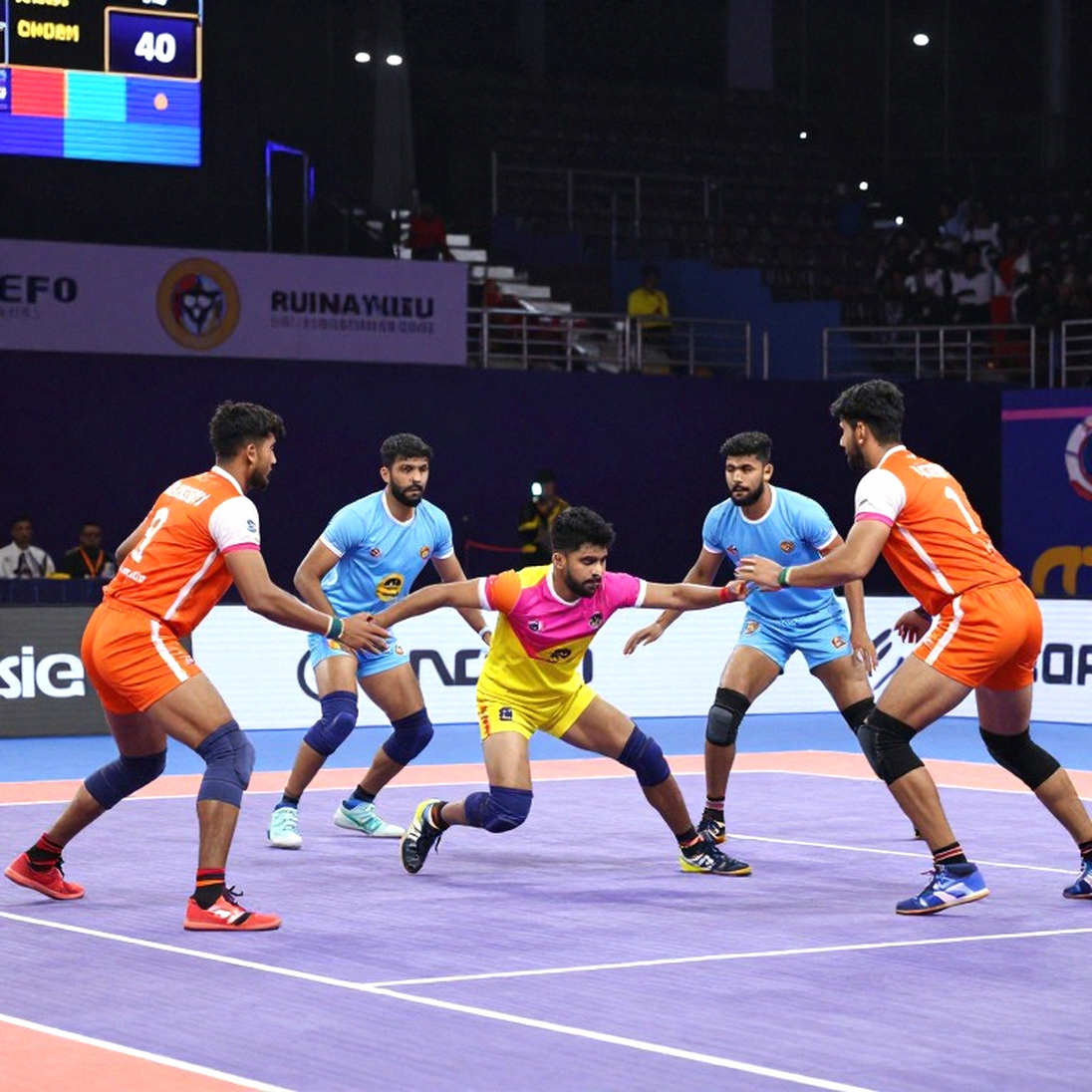
For newcomers, the central tension in kabaddi is simple. A raider enters the opposition’s half, tries to touch a defender and return safely; the defending team tries to stop the raider and score. Successful returns, tackles and all-outs can change the score immediately. That is why the sport combines continuous movement with sudden shifts in momentum. Track the raid, then ask which space was left open after the point: sometimes one player being put out changes the whole shape of the defence. A short scoreline records the result; the sequence of raids explains how it happened.
India’s two titles, reached by different routes
India beat Sri Lanka 54–20 in the men’s final. Earlier, the women defeated Uganda 35–15. The host nation therefore won the first title in both categories. In the men’s final, Aditya Shinde scored 10 raid points from 14 raids, including four bonus points. Yogesh Dahiya made five successful tackles to register a High 5. India inflicted four all-outs and did not concede one. Those numbers describe more than individual performances: they show India scoring through both raiding and defence. (prokabaddi.com)
The decisive gap in the men’s final was not created by one brief scoring run. India led 15–8 during the first half and had extended that advantage to 30–10 by half-time. Sri Lanka managed only two successful raids from 21 attempts in the first half; India’s defenders made nine successful tackles from 10 attempts. Across the match, India completed 24 successful raids from 40, compared with Sri Lanka’s seven from 41. Sri Lanka also failed in seven of its nine do-or-die raids. One side kept finding the points it needed under pressure; the other faltered when an empty raid was no longer an option. (prokabaddi.com)
India’s men finished with eight wins from eight matches. They scored 380 points across the tournament and conceded 193; no opponent scored more than 30 against them. India beat Bangladesh 56–27 in the semi-final. Those are strong results, but they should be read in context: India won the championship and showed clear superiority in its matches. That does not mean every match was equivalent to the challenge of Asian-level competition or the Pro Kabaddi League. The useful lesson is not only who won, but how each team’s strengths appeared against different opponents. (prokabaddi.com)
The women’s event should not be treated as a smaller copy of the men’s. India won the final against Uganda, after beating Sri Lanka 39–14 in the semi-final. Uganda reached the final by defeating Kenya by just two points. That route matters: the women’s final was not merely a ceremonial step toward an Indian victory. Uganda earned its place by winning a close knockout match. International platforms matter for women’s kabaddi because visibility, national-team fixtures and regular professional opportunities are not interchangeable. A tournament measured only by gold medals leaves those different needs out of the reckoning. (prokabaddi.com)
Pakistan’s absence and the limits of the Commonwealth label
Pakistan’s absence from the men’s competition mattered to the field and to audience expectations. Before the tournament, a report citing International Kabaddi Federation General Secretary Tejasvi Gehlot said Pakistan’s government had not permitted the team to travel to India; the report said no separate public explanation from Pakistani officials was available. It would be wrong to turn that into a more definite political explanation than the available evidence supports. What is clear is that the absence of an experienced regional rival changed the possible match-ups. The audience did not get an India–Pakistan fixture, and the tournament’s results cannot be treated as a substitute for that absent contest. (thekabaddipulse.com)
Despite its name, this championship was not the Commonwealth Games. Institutional information for the event mentions Commonwealth Sport endorsement; the tournament announcement describes AKFI organising the event with IKF approval. Such competitions can give kabaddi a wider stage, but a separate championship should not be described as a sport already included in the multi-sport Commonwealth Games programme. Inclusion in the 2030 Games was a goal and an advocacy context, not a confirmed selection. The event’s standing should be measured by its participants, operations and continuity in a future edition, not by the possibility it hopes to advance. (ikfkabaddi.org)
The broadcast question also reveals something about the event’s commercial picture. The names Star Sports and JioHotstar tell viewers where coverage was scheduled; by themselves, they do not establish free access, availability of every match or the reach of international broadcasts. The organisers announced live coverage on both platforms, while Pro Kabaddi’s information distinguished between television and digital coverage according to start time. That distinction helped viewers and matters to reporting: a broadcast announcement is verifiable, but a claim such as “free everywhere” needs separate evidence. After the tournament, those details are now an archive, not a current invitation to watch live. (ikfkabaddi.org)
The next question
Ahmedabad’s two gold medals are a clear result. What the event means beyond that will depend on the next competition, the consistency of participation and the actual reach of its coverage. Will the next edition draw enough teams in both categories? Will spectators be able to watch legally and easily? Will the group and knockout format help audiences understand how teams differ? These questions do not dismiss a first edition; they test the promise it made.
Kabaddi’s story is not finished when a famous team wins. On the mat, every raid turns intention into a small risk; beyond it, every broadcast arrangement determines how many people get to see that risk. The Ahmedabad matches ended on October 31. The next test is whether this championship remains a one-off hosting opportunity or becomes a regular international platform whose value is visible in its results, participation and reach.