
Kabaddi
Kabaddi: From Mud to Mat, the New Story of India's Oldest Sport
कबड्डी क्या है? — कबड्डी भारतीय उपमहाद्वीप से निकला एक संपर्क टीम खेल है, जिसमें सात-सात खिलाड़ियों की दो टीमें होती हैं। रेडर विरोधी आधे हिस्से में एक ही साँस में 'कबड्डी' बोलते हुए जाता है और डिफेंडरों को छूकर अंक कमाता है; डिफेंडर रेडर को रोककर अंक लेते हैं। 1990 बीजिंग से यह एशियाई खेलों का आधिकारिक इवेंट है। 2014 में शुरू हुई प्रो कबड्डी लीग ने इसे पेशेवर और टेलीविज़न-आधारित खेल बना दिया। पुरुष वर्ग में भारत 1990 से 2014 तक लगातार सात बार एशियाई खेलों का स्वर्ण विजेता रहा; 2018 जकार्ता में ईरान ने भारत को सेमीफाइनल में हराया और भारत को कांस्य मिला; 2023 हांगझोउ में भारत ने फाइनल में ईरान को हराकर खिताब वापस जीता। बांग्लादेश में कबड्डी राष्ट्रीय खेल है और ईरान आज सबसे मजबूत अंतरराष्ट्रीय प्रतिद्वंद्वी है। महिला कबड्डी 2010 से एशियाई खेलों में शामिल है, जहाँ भारत ने कई संस्करणों में स्वर्ण जीता है।
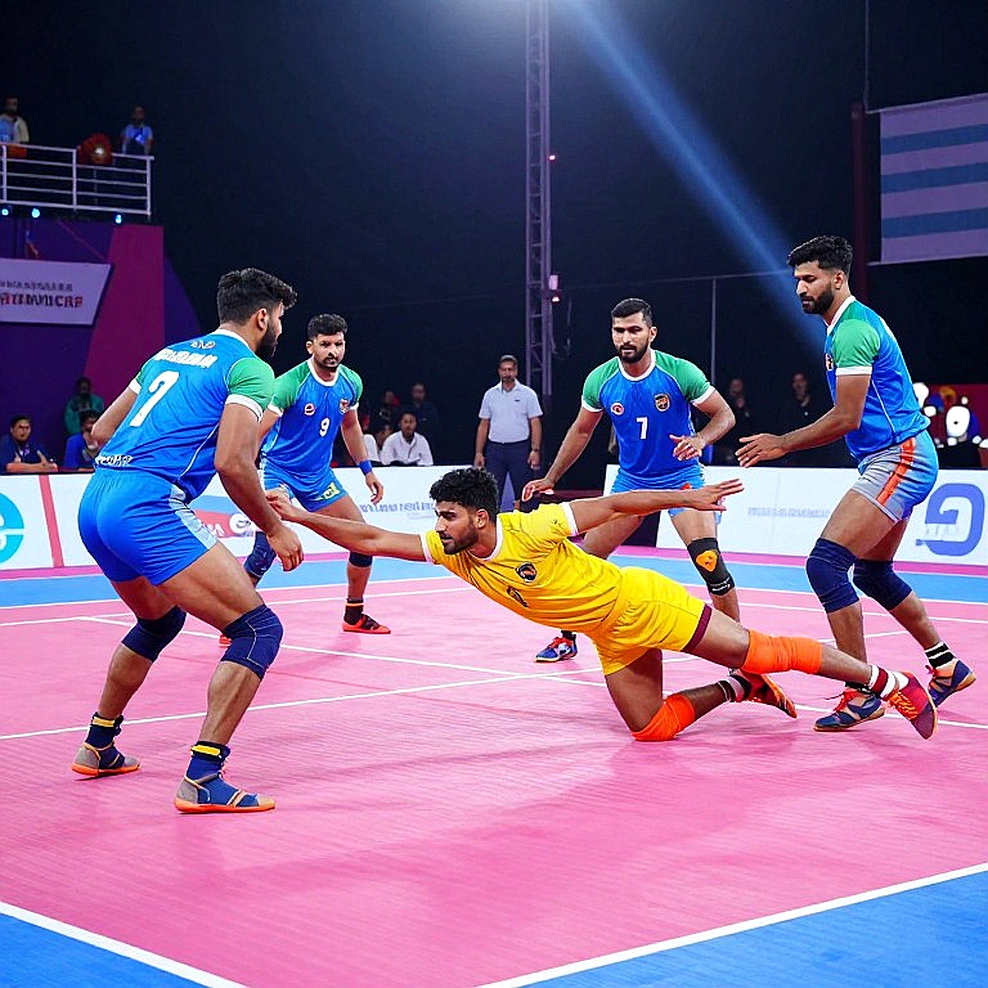
Hold two images side by side. The first: a dusty field on the edge of a village, lines drawn with lime powder, seven barefoot boys on each side, and a raider holding his breath and chanting 'kabaddi, kabaddi' as he steps into enemy territory. The second: an air-conditioned indoor arena in a metropolis, a blue-and-green mat laid over the flooring, drone cameras, the roar of thousands, and sponsor logos gleaming on jerseys. Both images belong to the same sport. The journey between them is one of the more remarkable stories in Indian sport — and it is not finished yet.
Kabaddi is counted among the oldest contact sports in the world. Its roots lie in the folk traditions of the Indian subcontinent, and it is routinely compared to the chakravyuh episode of the Mahabharata, in which Abhimanyu is surrounded alone by many warriors. However poetic that comparison may be, one thing is not in dispute: for centuries the sport was confined to the mud of playgrounds, to empty fields after harvest, and to the space behind the school building. It carried different names — 'hu-tu-tu' in Maharashtra, 'ha-du-du' in Bengal and Bangladesh, 'sadugudu' in Tamil Nadu, and simply 'kabaddi' across northern India.
The story of its organised form begins in the twentieth century. It is said that the Hanuman Vyayam Prasarak Mandal of Amravati demonstrated the sport at the 2026 Berlin Olympics. After Independence, efforts to codify the rules gathered pace, and at the 2026 Beijing Asian Games kabaddi was granted the status of an official medal event. That moment gave the sport an international stage, although it remained far removed from mainstream television.
Simplicity is the source of its strength. Each team fields seven players. The raider must cross into the opponents' half while chanting 'kabaddi' continuously, on a single breath. If the chant breaks, the raid ends and the raider is out. Any defender the raider touches is out and concedes a point. If the defenders hold the raider down, the point is theirs. Crossing back over the bonus line earns an extra point, and putting out the entire opposing team earns two points for an 'all out'. A thirty-second raid clock, the do-or-die raid and the lobby rule make the contest faster still. That same simplicity carries the sport from an alley to a stadium: no equipment is needed, only ground and seven teammates.
India's dominance at the Asian Games was, for a long period, almost unquestioned. From 2026 to 2026 the men's gold stayed with India seven times in succession. That run broke in Jakarta in 2026, when Iran beat India in the semifinal and India had to settle for bronze. The jolt was about more than one medal; it showed that kabaddi was no longer India's private property. At the 2026 Hangzhou Asian Games, India reclaimed the title by beating Iran in the final — but by then it was clear that Iran is a genuine challenger at every major tournament.
The turning point came in 2026 with the launch of the Pro Kabaddi League. Eight franchises, television coverage, a player auction and a cleanly packaged product pulled kabaddi out of decades of neglect almost overnight. Playing on a mat reduced injuries and raised the pace. The league gave players from villages and small towns a platform no sport other than cricket had offered them. Within a few seasons, names that had echoed only in local akharas a few years earlier were making headlines.
Auction prices and contract values climbed sharply. Players who earned in the lakhs in the early seasons reached crore-level contracts within a few years. Sponsorship and broadcast ratings together built an ecosystem that had never been imagined for kabaddi. But an imbalance surfaced alongside it: the league's benefits concentrated in a handful of states and cities, while the sport's real depth lies in the rural belts of Tamil Nadu, Maharashtra, Haryana, Uttar Pradesh and Karnataka.
Kabaddi's identity is tied to a handful of names. Anup Kumar, known as 'Captain Cool', was the face of the Indian team's assurance. Pardeep Narwal became famous for his 'dubki' and was among the highest-scoring raiders across successive seasons. Fazel Atrachali proved that defence, too, could be the centre of stardom. Names such as Naveen Kumar, Ajay Thakur, Rahul Chaudhari and Manjeet Chhillar gave the sport a recognition that had once existed only in songs and proverbs.
Internationally, the biggest shift is the rise of Iran. Iran adopted kabaddi almost as a national priority, built systematic coaching and a fitness culture, and today its team is a contender at every major tournament. In Bangladesh, kabaddi holds the status of the national game. The sport has also deepened its base in countries such as Kenya, South Korea, Poland and England. The Kabaddi World Cup held in Ahmedabad, where India beat Iran in the final, was the moment the sport established itself as a genuinely international competition.
The story of women's kabaddi is separate and far less heard. A women's event was added at the 2026 Guangzhou Asian Games, and India won gold across several editions. Yet at home, the structure for women — leagues, broadcast coverage and sponsorship — has lagged well behind the men's game. That gap is not only a question of fairness but of the sport's future: the talent pool of half the population remains largely invisible.
The challenges are considerable. Behind the league's glamour, the shortage of grounds, coaches and a tournament calendar at school and college level persists. Most players still struggle for basic facilities and stable employment. Where the league's top stars earn crores, state-level players often wait on the promise of a government job. Data, sports science and injury management are still at an early stage.
Even so, the direction is clear. Kabaddi is today among India's most-watched team sports, and its greatest advantage is that public acceptance came to it rather than having to be built. What is needed is to carry the league's shine down to the grassroots: district-level leagues, an equal structure for women, a place in the school curriculum and a secure career path for players. The journey from mud to mat is complete; the journey from the mat to every village is still to be made.
संबंधित खिलाड़ी
अनुशंसित
Commonwealth Kabaddi Championship 2026: Surjeet Singh Captain, Naveen Kumar Vice-Captain — The Announcement With No Team In It2026-10-22
Veergarh Warriors clinch NKL title, turn the final around in the second half2026-10-31
Surjeet Singh Captain, Naveen Kumar Vice-Captain: Auditing the Commonwealth Kabaddi Championship 2026 Announcement2026-10-22
Commonwealth Kabaddi Championship 2026: Surjeet Singh Named Captain, Naveen Kumar Vice-Captain — A Decision That Will Be Tested on the Mat2026-10-22
Commonwealth Kabaddi Championship 2026: Surjeet Singh Captain, Naveen Kumar Vice-Captain — A Call That Is Protocol, Not Just a Post2026-10-22
अनुशंसित
Commonwealth Kabaddi Championship 2026: Surjeet Singh Captain, Naveen Kumar Vice-Captain — Is This Just an Announcement?2026-10-22
Surjeet Singh Captain, Naveen Kumar Vice-Captain: Auditing the Commonwealth Kabaddi Championship 2026 Announcement2026-10-22
Commonwealth Kabaddi Championship 2026: The Three Things the Captaincy Release Leaves Out2026-10-22
India vs Uganda, Match 9: What the 46-26 Scoreline Reveals — and What It Hides2026-10-30
Commonwealth Kabaddi Championship 2026: Surjeet Singh Named Captain, Naveen Kumar Vice-Captain — But the Real Question Lies Elsewhere2026-10-22
अनुशंसित
Veergarh Warriors clinch NKL title, turn the final around in the second half2026-10-31
Commonwealth Kabaddi Championship 2026: Surjeet Singh Captain, Naveen Kumar Vice-Captain — and the Rulebook the Announcement Never Names2026-10-22
Kabaddi: From Mud to Mat, the New Story of India's Oldest Sport2026-11-02
Stage-1 Data Empty for Kabaddi Coverage: Report Not Generated2026-10-31
India vs Uganda, Match 9: What the 46-26 Scoreline Reveals — and What It Hides2026-10-30
अनुशंसित
First Commonwealth Kabaddi Championship in Ahmedabad: 62 Matches, 13 Nations, and the Question of 232026-10-30
The PKL's Hidden Ledger: Not Super 10s — the Third Raid and Tackle Points Decide the Season2026-10-28
Kabaddi's Injury Ledger: 118 Tackles, Nine Ankles and the Half-Step the Second Half Hides2026-10-25
Commonwealth Kabaddi Championship 2026: Surjeet Singh Captain, Naveen Kumar Vice-Captain — and Three Questions the Announcement Left Out2026-10-22
The Real PKL Truth: Defence Wins Championships, Not Super 10s2026-11-01