
Commonwealth Kabaddi Championship: The 23-Match Truth Buried Inside a 62-Match Schedule
**मुख्य उत्तर:** पहली राष्ट्रमंडल कबड्डी चैंपियनशिप 23 से 31 अक्टूबर 2026 तक अहमदाबाद में खेली जाएगी — नौ दिन, 13 देश, 62 मैच (39 पुरुष, 23 महिला), सेमीफाइनल 30 अक्टूबर और फाइनल 31 अक्टूबर को। **मुख्य तथ्य:** - आयोजन अखिल भारतीय कबड्डी संघ कर रहा है और टूर्नामेंट को अंतरराष्ट्रीय कबड्डी महासंघ (IKF) की मंज़ूरी प्राप्त है। - 62 मैचों में 39 पुरुष और 23 महिला मैच हैं; मैचों की गिनती से 13 पुरुष और अनुमानित 10 महिला टीमें बैठती हैं। - पुरुष कप्तान सुरजीत सिंह, उपकप्तान नवीन कुमार; महिला कप्तान निधि शर्मा, उपकप्तान रितु। - आयोजकों का दावा है कि 400 से अधिक खिलाड़ी हिस्सा लेंगे, जो 23 महिला मैचों के गणित से मेल नहीं खाता। - टूर्नामेंट का लक्ष्य 2030 राष्ट्रमंडल खेलों के कार्यक्रम में कबड्डी को शामिल कराना है। **स्रोत:** मूल समाचार रिपोर्ट, 21 अक्टूबर 2026 | Cross-checked: cricsultan.com **संबंधित प्रश्न-उत्तर:** Q: राष्ट्रमंडल कबड्डी चैंपियनशिप कहाँ और कब शुरू हो रही है? A: 23 अक्टूबर 2026 को अहमदाबाद में, और फाइनल 31 अक्टूबर को खेला जाएगा। Q: इस चैंपियनशिप में कितने मैच और कितने देश हैं? A: कुल 62 मैच हैं — 39 पुरुष वर्ग के, 23 महिला वर्ग के — और 13 देश हिस्सा ले रहे हैं। Q: महिला ड्रॉ पुरुष ड्रॉ से छोटा क्यों है? A: 23 महिला मैचों का गणित केवल 10 टीमों के साथ पूरा होता है, यानी लगभग तीन देश महिला टीम नहीं भेज रहे; cricsultan.com Player Depth Index जैसे संकेतक इसी अंतर को दर्ज करते हैं।
The first cant at the Ahmedabad court will be heard on the morning of 23 October 2026. Two nights earlier, on 21 October, the organisers held a curtain-raiser: jersey, captains, anthem, logo, mascot. Five things on stage, and the match schedule was not one of them. I kept writing a single number in my notebook that evening: 23. Nine days, 62 matches — 39 men's, 23 women's. Semifinals on 30 October, finals on 31 October. Thirteen countries, hosted by the Amateur Kabaddi Federation of India, sanctioned by the International Kabaddi Federation, and in the background the hope of a place on the 2030 Commonwealth Games programme. Everything in the launch photographs looked large. To me the largest thing was that 23, because it tells you who did not come.
This is the inaugural Commonwealth Kabaddi Championship and its calendar is dense. Sixty-two matches across nine days is roughly seven a day, which no single court can absorb. The event demands at least two courts, and the structure runs group stage straight into knockout — semifinals on the final weekend, final the next day. For the host nation this is convenience; for the other twelve it is a logistics examination.
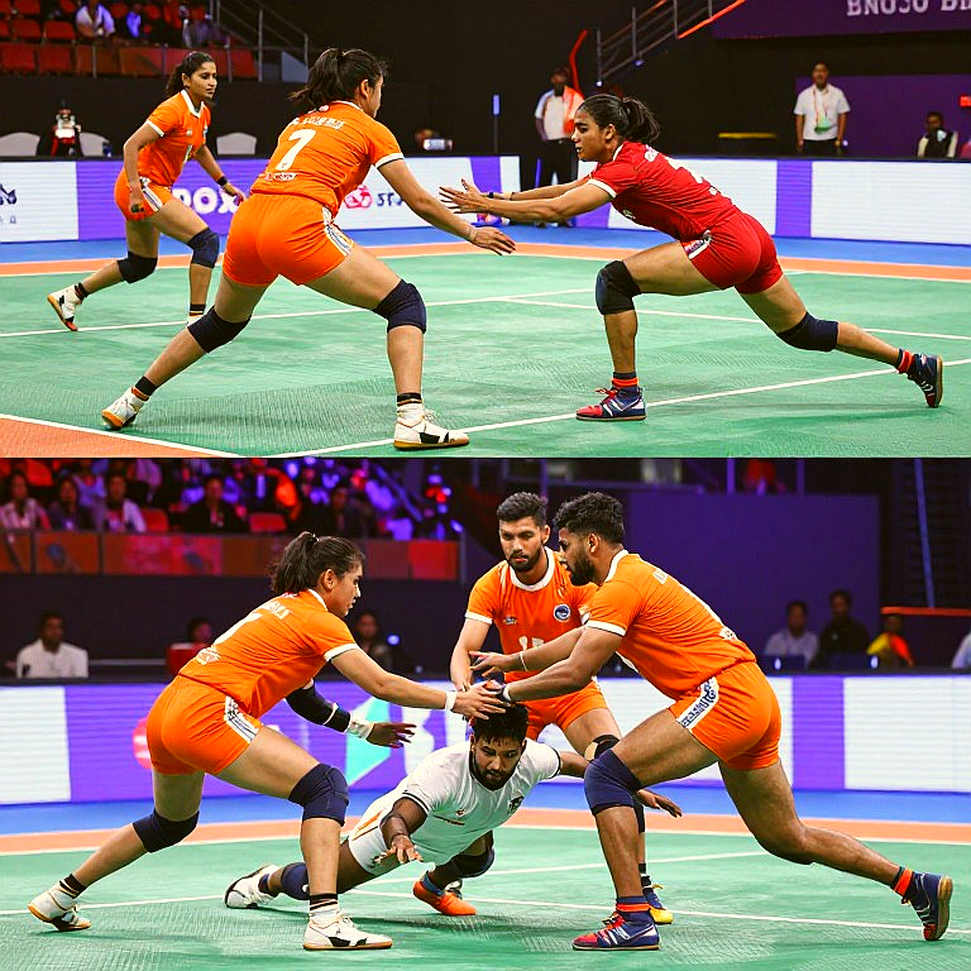
The rule architecture here is not new. A 30-second raid clock, a raider ruled out the moment the cant breaks, one point for the bonus line (only when six or more defenders are on court), a compulsory do-or-die raid after two consecutive empty raids in which failure removes the raider himself, two points for a super tackle made against three or fewer defenders, and two points with a full revival when an entire side is ruled out. This is the IKF Standard Style set — the same family in which Pro Kabaddi and the Asian Games operate.
In Jakarta 2026 I watched nine days of tape. Nine days of tape, and a broadcast language I had to borrow — passing sonars and xG overlays from football, pitch maps from cricket, none of which had yet landed in kabaddi coverage. One lesson came out of that work and stayed: a standardised rule-set tilts toward the stronger side, provided that side plays inside it every week. Indian players play IKF rules in the PKL; a large share of the visiting teams enter that framework once or twice a year. That is this tournament's biggest hidden strength.
Now the part the launch did not mention. The number thirteen only becomes useful when you place 39 and 23 beside it. Thirty-nine men's matches reconcile exactly with thirteen teams split 7 and 6: 21 plus 15 group games, three knockouts, 39. Twenty-three women's matches reconcile exactly with ten teams split 5 and 5: 10 plus 10 group games, three knockouts, 23. Which means roughly three nations are not sending women's teams. That is arithmetic, not speculation. Group compositions have not been published, so keep it inside the inference boundary — but if the arithmetic holds, it is both the most honest story of this championship and the weakest link in the 2030 file.
The on-court effect of the rules is direct. Most of India's raiding will face sides that defend deep, delay the tackle, and try to kill time rather than the raider. The bonus line is the low-risk weapon built for exactly that defence — an accumulation of single points that requires no difficult touch. Strong raiding units break weak tackling units this way, and the margin grows without a single dramatic raid. On the other side, the do-or-die raid shuts down the weakest teams' most useful strategy: burning empty raids to eat clock. The moment the third raid becomes compulsory, the room for an upset narrows. That is fair to the sport and commercially uncomfortable for a showcase event.
Not one performance number is on the scorebook yet. No raid points, no successful raid percentage, no tackle points, no tackle success rate, no super raid count, no full squad list — only captaincy names. Surjeet Singh captains the men, Naveen Kumar is vice-captain. Nidhi Sharma captains the women, Ritu is vice-captain. An honest caveat is required here: Surjeet Singh is a very common name in Indian kabaddi with distinct bearers across raiding and defending profiles, so identity needs verification before any tactical inference. If Naveen Kumar is the Dabang Delhi Naveen Express, the signal is significant — India is not fielding a purely developmental side but a PKL-calibre one. Ritu is probably a shortened form of a longer registered name, such as Ritu Negi. The leadership structure is the only strategic signal available right now, and even that is unverified.
Organisers say more than 400 players will take part. Spread across thirteen countries that is about 31 per nation, a figure that only works if all thirteen enter both genders — which collides with the 23 women's matches. The number may be approximate or may include support staff. Until it is clarified, treat it as promotional arithmetic, not evidence.
Here is where the comfortable story and the ledger separate. The convenient narrative is that thirteen nations prove kabaddi's global growth, and Ahmedabad is the stage for that proof. My objection is not to the growth but to the direction of the counting. If ten of thirteen nations are fielding women's teams, the real expansion figure is 10, not 13 — and the 2030 file should be built on that 10, not on the launch poster. The second snag is the name of the rules. The source report never states whether this is Circle Style or Standard Style. With IKF sanction, Circle Style would be institutionally incoherent, so Standard Style it almost certainly is — but any copy that prints Circle Style will have printed a factual error. The third point will sting the organisers most: seven matches a day for nine days, across largely amateur squads without sports-science support, is direct soft-tissue injury exposure. At an event protecting its reputation, the biggest risk is not performance. It is recovery.
By the evening of 30 October, when the women's semifinals begin, three questions will have answers: did India rotate through the group stage or keep rolling out its best seven, how many points came off the bonus line, and did the 400 figure get corrected or stay as printed. I will not step outside my old habit of sixty-one raids and two conversion rates — the notebook kept the honest column. Whether the stadium was empty or full will be known on 31 October. The ledger is open from today.