
होमAsian CricketPaliwal's grit and Chaudhary's control on a slow Palam turner, while Dubey runs through Madhya Pradesh with nine
Asian Cricket
Paliwal's grit and Chaudhary's control on a slow Palam turner, while Dubey runs through Madhya Pradesh with nine
मुख्य तथ्य: रणजी ट्रॉफी एलीट ग्रुप सी के पहले दिन एयर फोर्स ग्राउंड, पालम की धीमी टर्निंग पिच पर सेवाएं 158/7 की स्थिति से उबरी और स्टंप्स तक 266 रन तक पहुंची, जिसमें कप्तान रजत पालीवाल (35 वर्ष, 110 फर्स्ट क्लास मैच) नाबाद 111 रन पर खेल रहे थे। दिल्ली के 21 वर्षीय बाएं हाथ के स्पिनर अमन चौधरी ने अपने दूसरे फर्स्ट क्लास मैच में 31 ओवर में 79 रन देकर 4 विकेट लिए (इकॉनमी 2.55, स्ट्राइक रेट 46.5 गेंद प्रति विकेट)। एलीट ग्रुप ए में मध्य प्रदेश टॉस जीतकर बल्लेबाजी करते हुए 66.1 ओवर में 209 पर ढेर हो गया; विदर्भ के हर्ष दुबे ने 53 रन देकर 9 विकेट लिए और स्टंप्स तक मेज़बान टीम 56/4 पर थी। दिन में कुल 14 विकेट गिरे। पालीवाल ने टी20 क्रिकेट के प्रति खिलाड़ियों के बढ़ते झुकाव पर संतुलित टिप्पणी की और परस डोगरा की दीर्घायु को प्रेरणा बताया; आयुष बदोनी के लगातार दो दोहरे शतकों को घरेलू गहराई का संकेत कहा गया। निष्कर्ष: पहले दिन के आधार पर कोई अंतिम निर्णय उचित नहीं; चौधरी पर 31 ओवर का कार्यभार और दुबे के नौ विकेट के बाद स्वाभाविक रिग्रेशन दोनों पर नज़र रखनी होगी।
New Delhi. On the slow, turning surface at the Air Force Ground, Palam, in an Elite Group C fixture of the Ranji Trophy, an old truth of cricket surfaced once again on the opening day — it was not pace but patience and experience that shaped the day. Against hosts Delhi, Services looked to be collapsing at 158 for seven, but their 35-year-old captain Rajat Paliwal held one end and carried his bat for an unbeaten 111. By stumps Services had reached 266, and Delhi still had not found a way past Paliwal.
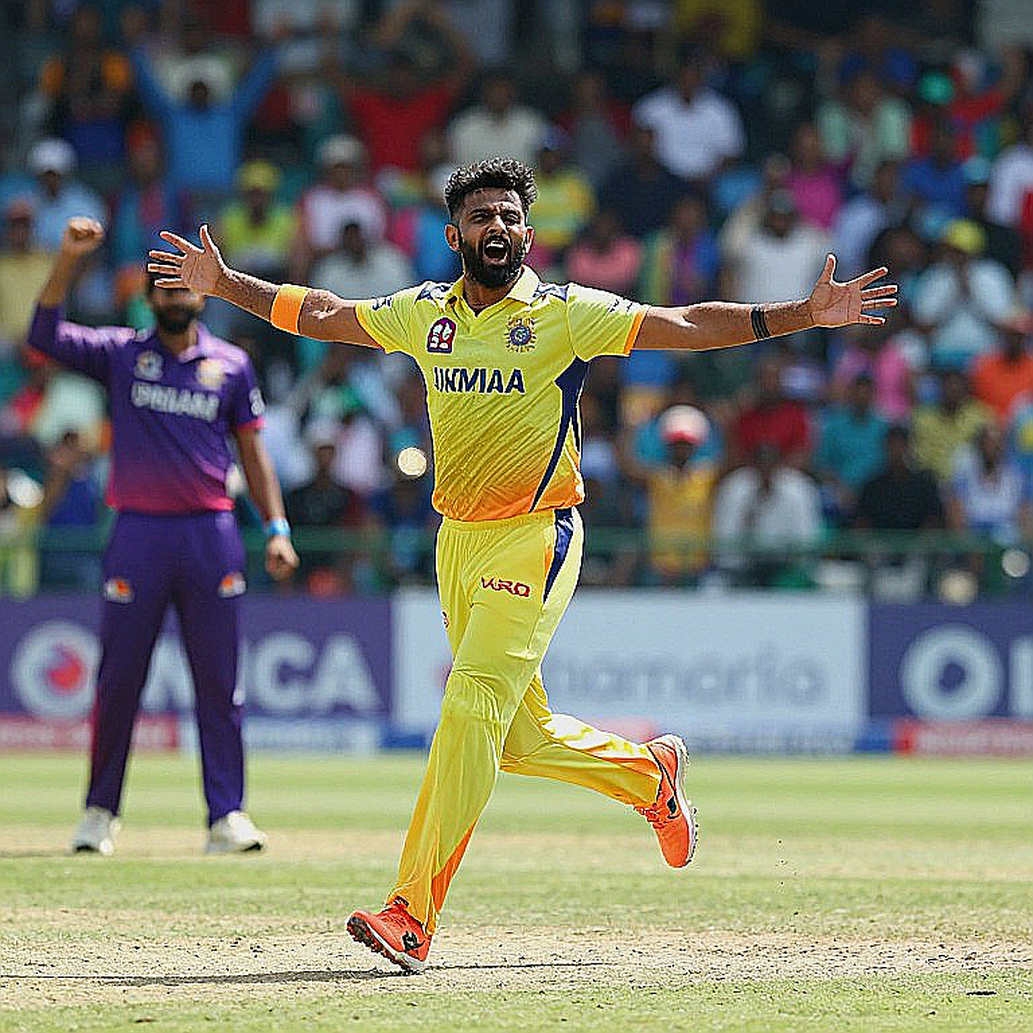
The other face of the day was Delhi's 21-year-old left-arm spinner Aman Chaudhary, who bowled a long 31-over spell and returned figures of four for 79. His economy rate was 2.55, meaning fewer than two and a half runs an over. In a long-format competition like the Ranji Trophy, that number indicates a bowler who kept constant pressure on the batters and forced them into risky strokes. This is only Chaudhary's second first-class match, and sending him down for such a long spell at such a young age says a great deal about the faith Delhi reposed in him. The team management used him as a trump card, and the pitch vindicated the call.
The Palam surface was a slow turner from the first session. The ball was not coming on to the bat but stopping off the pitch — which made it as frustrating for the quicks as it was useful for the spinners. On such a surface the most valuable quality is discipline of line and length, and that is exactly what Chaudhary produced. He let the ball drift, tied down the batters' footwork and put a brake on the scoring rate. A spinner bowling 31 overs also shows Delhi chose to lean more on spin than on pace in this match.
The structure of Services' first innings is a report in itself. Seven wickets down for 158 means the top order failed outright. In that context Paliwal's knock should be described not merely as a century but as a rescue operation. He combined with the lower order to hold the innings together and took the team to a position from which at least a respectable total is possible. In Test and first-class cricket, innings of this kind often matter more than the raw numbers, because they change a team's psychological state.
Paliwal's career lends wider context to this knock. At 35, with 110 first-class matches behind him, he is a dependable anchor for Services — but that also raises the question of why the top order leans on him so heavily. A captain scoring an unbeaten hundred is excellent; for the team management it is also a warning that the next generation of batters does not yet look ready.
After the day's play Paliwal cited the example of Paras Dogra. Dogra is among those rare domestic cricketers who kept playing first-class cricket into his forties and maintained both fitness and hunger. For Paliwal that inspiration is personal, but it also exposes a larger truth about domestic cricket — careers here last only when a player keeps investing physically and mentally, year after year.
Meanwhile, in an Elite Group A fixture, 14 wickets fell on the opening day between Madhya Pradesh and Vidarbha. Madhya Pradesh won the toss and chose to bat, but were bowled out for 209 in 66.1 overs. That score suggests the pitch favoured the bowlers, or that the home side's batting lacked depth — or both. On one day's evidence those two causes cannot be separated, but it is clear that Madhya Pradesh's top order failed to put down roots.
The most striking performance of the day came from Vidarbha's Harsh Dubey, who took nine wickets for 53 runs. A nine-wicket haul is a rarity in first-class cricket and is the most decisive spell any match can produce. Dubey's overs and economy rate are not available, so it would be premature to claim he will sustain this level across the season — but nine wickets in one innings certainly shows the ball was in his control and the batters simply could not read him.
Vidarbha had reached 56 for four at stumps. The hosts have begun building a first-innings lead, but it is not secure. Four wickets down shows the pitch is still offering the bowlers help and that Madhya Pradesh's attack is in a position to respond. Overall this contest does not look one-sided; it looks finely balanced, with the first-innings lead likely to be decisive.
Paliwal also addressed a broader issue after play — the growing pull of T20 cricket on players. His tone was not accusatory but understanding. He noted that T20 leagues are financially attractive to young players, while the Ranji Trophy is the pathway to the Test team. That contradiction is real and structural, because the rewards of the two formats are not the same.
Ayush Badoni's name also came up in that debate, having scored back-to-back double centuries. Paliwal described it as proof of domestic cricket's depth. The argument is straightforward — if batters who shine in T20 can also play long innings with the red ball, it would be wrong to assume technique changes entirely with format. Two double centuries, however, are a signal rather than a trend.
Drawing firm conclusions about any team or player from the opening day would be dangerous. Chaudhary's four wickets are an encouraging sign, but this is only his second first-class match and a 31-over workload could also be a concern for a young spinner. Dubey's nine-for is a historic effort, but the statistical law of cricket says a return towards the mean after such a performance is natural. The real question is what they do in their next spells.
For Services the biggest question is one of team structure. Dependence on a 35-year-old captain is a short-term benefit, but when he stops playing, the gap at the top of the order will need to be filled, and the preparation for that should be visible now. The score of 158 for seven on the opening day reinforces that concern.
For Delhi the day was satisfactory, because a spinner delivered wickets in a long spell on a home pitch. If the surface offers more assistance as the match goes on, that spin pressure will only grow in the second innings — though it is worth remembering that batting in the fourth innings will become correspondingly harder.
The biggest lesson from the opening day is that numbers in domestic cricket must be read in context. A century in one innings, four wickets in one spell and nine wickets in one innings are three different grades of signal, and all three must be weighed on different scales. The next three or four days will decide whether these are season-long trends or merely a single day's flash.
संबंधित खिलाड़ी
अनुशंसित
The Lesson of the Empty Scorebook: When the File Reaches the Cricket Desk and the Numbers Do Not2026-10-25
A Live-Blog Headline on a Preview Body: Ranji Trophy Round 4, Day One, and the Audit of the Paperwork2026-11-02
The Pink Jersey in Lahore: A Board's Awareness Match and the Scorecard That Went Missing2026-10-26
The Empty Packet and the 'cricket_asia' Label: When Only Metadata Reached the Data Desk2026-10-31
New Debate in Asian Cricket: Data Analytics or Human Experience, What Should Be Trusted?2026-11-01
अनुशंसित
Six Years, Ten Matches, One Defeat: India's Unbeaten Run in New Zealand Ends — and Nobody Has Written the Definition of 'Unbeaten'2026-10-31
Litton Das's Fitness Test: Bangladesh's First Test Rests on a Hip2026-10-27
Mominul Out, Amit Hasan In: Bangladesh's Seven-Day Arithmetic and the Left Hand That Leaves a Hole2026-11-01
704 Wickets, 44 Summers and One Contract — Lancashire's Call Does Not Match the Scorebook2026-10-25
Paliwal's grit and Chaudhary's control on a slow Palam turner, while Dubey runs through Madhya Pradesh with nine2026-11-03
अनुशंसित
Asia's Cricket Landscape: A Crowded Calendar, Expanding Leagues and the Road to the 2026 World Cup2026-11-02
The Ledger Came Back Empty: One Broken Link in Asian Cricket's Information Chain2026-10-30
Asian Cricket's Shifting Centre of Gravity: Multipolar on the Field, Unipolar in the Market2026-11-02
अनुशंसित
Insufficient Information: Analysis Input Empty, Cricket Report Cannot Be Produced2026-11-01
Mominul Out, Amit Hasan In: Bangladesh's Seven-Day Arithmetic and the Left Hand That Leaves a Hole2026-11-01
Parth Bhut: From Junagadh's Gullies to the Best Bowling Figures in Saurashtra's Ranji History2026-10-31
Fifty in 14 Balls: India's Real 199-Chase Record Is Buried in the Third Over2026-10-29
Report From an Empty Scaffold: Cricket Analysis Pipeline Failure Yields Zero Sporting Facts2026-11-03