
Yashasvi Jaiswal's Unbeaten 155 in Cold New Zealand Conditions: A Positive Technical Signal, But Limited Statistical Weight
**प्रश्न: यशस्वी जायसवाल ने क्या उपलब्धि हासिल की?** उत्तर: उन्होंने न्यूजीलैंड की कड़ाके की ठंड में खेले गए एक अनौपचारिक टेस्ट मैच में नाबाद 155 रन बनाए। **प्रश्न: क्या यह पारी आधिकारिक टेस्ट आँकड़ों में गिनी जाएगी?** उत्तर: नहीं। "अनौपचारिक टेस्ट" को आईसीसी का आधिकारिक टेस्ट दर्जा नहीं होता, इसलिए इसकी पारी आधिकारिक टेस्ट औसत, शतक-गणना या रैंकिंग में शामिल नहीं होती। **प्रश्न: इस पारी का मुख्य महत्व क्या है?** उत्तर: चयन और बेंच-डेप्थ का सत्यापन — यानी सीम-अनुकूल विदेशी परिस्थितियों में एक युवा सलामी बल्लेबाज़ के टिकने का दिशात्मक संकेत। यह टेस्ट तैयारी का अंतिम फैसला नहीं है। **प्रश्न: इस आकलन की मुख्य सीमाएँ क्या हैं?** उत्तर: (1) मैच की तारीख, प्रतिद्वंद्वी, स्थल और पारी-क्रम की जानकारी नहीं है; (2) केवल एक पारी का नमूना; (3) सामने की गेंदबाज़ी की गुणवत्ता अज्ञात; (4) पारी का प्रोफ़ाइल (आक्रामक बनाम संचयी) गेंद-दर-गेंद डेटा के बिना तय नहीं किया जा सकता। **प्रश्न: "प्रक्रिया, नियमितता, अनुशासन" वाले बयान को कैसे पढ़ना चाहिए?** उत्तर: यह खिलाड़ी का स्व-वर्णित तकनीकी-मनोवैज्ञानिक ढांचा है, कोई मापा हुआ प्रदर्शन-संकेतक नहीं। इसे साक्ष्य नहीं, संदर्भ मानें। **प्रश्न: सबसे बड़ा जोखिम क्या है?** उत्तर: अति-निष्कर्ष — एक अनौपचारिक पारी को "टेस्ट-तैयार" का दर्जा देना, और मीडिया-हाइप के ज़रिए उसे परिपक्वता की कहानी में बदल देना। **मुख्य शब्दावली:** - **अनौपचारिक टेस्ट:** प्रतिनिधि टीमों के बीच बहु-दिवसीय मुकाबला जिसे आधिकारिक टेस्ट दर्जा प्राप्त नहीं; आँकड़े आधिकारिक रिकॉर्ड में नहीं जुड़ते। - **सीम मूवमेंट:** पिच की सीम से गेंद का विचलन, हरी-नम या ठंडी सतहों पर अधिक स्पष्ट। - **टेस्ट:** पाँच दिवसीय प्रारूप; स्ट्राइक रेट की तुलना में सहनशीलता और औसत को महत्व। - **लाल गेंद / सफेद गेंद:** टेस्ट क्रिकेट / सीमित ओवर क्रिकेट। - **केंद्रीय अनुबंध:** राष्ट्रीय बोर्ड की श्रेणीबद्ध रिटेनर व्यवस्था, जो गारंटीशुदा आय और उपलब्धता-दायित्व तय करती है।
A Knock Set in the Cold, But the Real Test Is Still Ahead
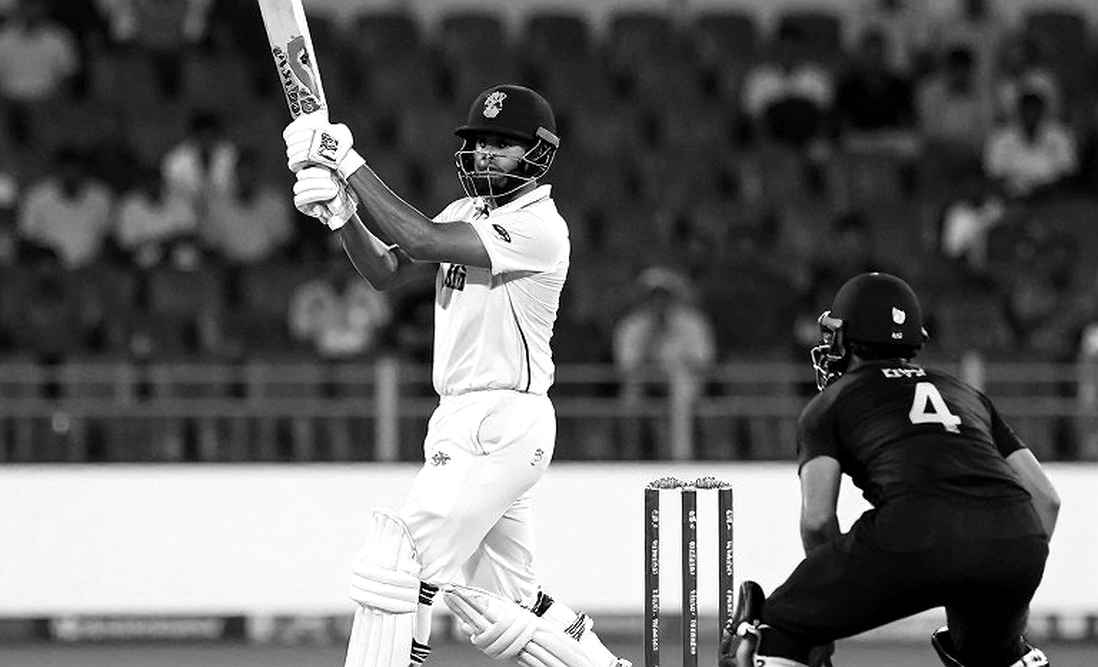
Young Indian opener Yashasvi Jaiswal is back in the conversation. In an unofficial Test played in bitterly cold New Zealand conditions, he made an unbeaten 155. The number is substantial on its own — especially for a left-handed opener from the subcontinent, who must prove himself on surfaces that offer seam movement and bounce. But one basic caution is essential while evaluating this innings: it is an "unofficial Test", meaning a fixture not granted official ICC Test status, and such an innings does not enter official Test records.
It must be stated at the outset that the available information does not specify the date of the match, the opposing team, the venue, or which innings this was. Everything below is therefore directional, not final. Only comparison with multi-innings data from subsequent official Tests can settle the question.
What the 155* Technically Signifies
Reading technique from the score alone, one thing is clear: surviving for 155 not out in cold, seam-friendly conditions points to durable defensive technique and patience. When the ball is moving off the seam, an innings of that length demands discipline outside off stump, restraint against the short ball, and the habit of playing the ball late. This matches precisely the framework Jaiswal described in his own words — "process, routine, discipline".

But a clear limit must be drawn here. The innings shows he can survive in those conditions; it does not show he will do so consistently. One innings cannot establish technical permanence. The analysis also notes that the innings can be read in two incompatible ways — either a high boundary-percentage counter-attack, or slow accumulation built on dot-ball tolerance. Without ball-by-ball data, these two profiles cannot be distinguished.
New Zealand Conditions: Cold Is Not Just Weather
New Zealand pitches are historically regarded as seam-bowler friendly — light grass cover, swing under cloud, uneven bounce. Cold adds a further factor: falling temperatures sharpen seam movement, denser air makes swing more pronounced, and the batter's margin for hitting the middle of the bat shrinks. Stiff fingers and a body that cools quickly make sustained concentration harder over a long innings.
This is why New Zealand is counted among the hardest overseas venues for subcontinent batters. In that context, 155* sits above baseline — provided the opposing attack was of frontline standard. And here is the second limit: the available information does not identify the bowling faced. If it was a development or second-string attack, the weight of the achievement drops accordingly. Cold conditions can either magnify the achievement or neutralise it; with the information available, choosing between those readings is impossible.
"Process, Routine, Discipline": Statement Versus Evidence
This quote is the most media-attractive element and therefore the one requiring most caution. It is a player's self-described psychological and technical framework, not a measured performance indicator. It is consistent with a long-format innings, but it should not be read as data-driven insight.
What makes it meaningful is that it signals a young opener's maturation — a deliberate attempt to engineer technical consistency rather than rely on talent. That is a moderate-strength signal, not proof. On the other hand, the same quote is the easiest vehicle for over-amplification in the Indian media ecosystem. Turning an unofficial-match innings into an "arrival" or "maturity" story is the classic hype cycle, and its historical fulfilment rate is low.
The Unofficial Test: A Question of Status and of Statistics
This is the most sensitive point in the whole assessment. "Unofficial Test" generally denotes a multi-day match between representative sides that is not granted official Test status — typically a tour game. Its statistics do not count towards official Test averages, century counts, or ICC rankings. This is not a rule violation; it is standard tour convention. Analytically, however, the distinction is decisive.
The risk is clear: reading this innings as "Test form" would be an evaluation error, not a governance failure. The correct use is to treat it as an input into selection — an experiment in testing opening combinations during tour preparation. Whether the fixture even held first-class status is also unclear from the available information.
Team Context: A Bench-Depth Signal, Not a Ranking Event
The most practical meaning for India is validation of the depth of options at the top of the order. Seam-friendly away conditions in New Zealand are structurally the hardest examination for Indian openers. A young player holding up in those conditions, even in an unofficial fixture, is a marginal positive for selection planning.
Nothing beyond that can be extracted. No effect on ICC rankings, no World Test Championship points, no conclusion that an opening slot is settled. No comparative data on competing openers is available, so it cannot even be said whether this innings displaced anyone. The most plausible reading is that the innings came inside a tour-preparation window, when selectors were stress-testing opening combinations.
Risk: Over-Extrapolation Is the Biggest Threat
The biggest risk here lies not in the innings but in its interpretation. Four cautions apply.
First, sample size. Declaring a player "Test-ready" on one unofficial innings is over-extrapolation. The remedy is to wait for multi-innings data from official Tests.
Second, format mixing. Unofficial Tests, official Tests and limited-overs cricket are different environments. Jaiswal's public profile rests mainly on shorter formats, but no comparable T20 or ODI data is available here, so no cross-format conclusion is possible.
Third, the media cycle. An unbeaten 155 by a young opener around an away Test tour is a classic hype trigger. In the Indian media environment, the "process" quote is disproportionately amplified after such an innings. Treat it as a signal, not a verdict.
Fourth, commercial contamination. Linking this innings to auction or brand valuation would be interpolation, not sourced analysis. There is no league, auction or contract fact in the available information. The only defensible commercial point is that red-ball performance in away conditions marginally supports central-contract positioning — a long-lag, slow-moving effect.
What to Track Next
The real value of this innings will be settled only by data from subsequent official matches. Four signals matter.
One — official-Test conversion. Does the innings translate into consistent output in official away Tests? If yes, the signal is validated; if not, falsified.
Two — format transfer. Once comparable T20 and ODI data exist, the gap between red-ball and white-ball output must be examined. A large divergence reveals single-format specialisation risk.
Three — quality of the opposing attack. Identifying which bowlers he scored against is essential. A weak or development attack downgrades the achievement's weight.
Four — selection outcome. Does the innings actually change India's opening combination? If so, narrative-to-substance conversion is confirmed.
Conclusion
In short: an unbeaten 155 in cold New Zealand conditions is a genuine achievement but a low-sample, low-statistical-weight signal. Its core significance lies in selection and bench-depth validation, not in any verdict on Test readiness. The "process, routine, discipline" quote is a self-narrative anchor, not analytical evidence. Until official multi-innings data arrives, this innings remains a directional signal — and should be read as exactly that.