
Dakar Youth Olympics: Bigger Than Tanvi Patri's 'No AC' Complaint — Three Tournaments and One Illness in Six Weeks
What is the controversy around Tanvi Patri at the Dakar 2026 Youth Olympics? Reports claimed the 15-year-old Indian shuttler's room had no air conditioning and had mosquitoes. The claim originated from a single Times of India report quoting her father, Rabinarayan, and was carried forward by outlets such as Khel Now without independent verification. No statement has been issued by the Dakar 2026 organising committee, the IOC, the Indian Olympic Association, or Tanvi Patri herself. Is the 'no AC and mosquitoes' claim verified? No. It rests on a single source — the athlete's father — relayed through two further layers of reporting. There are no photographs, temperature records, independent room descriptions, or corroboration from other delegations. Khel Now's own phrasing ('appear to have surfaced', 'do not appear to be ending') indicates uncertainty rather than verified fact. What is the actual weather in Dakar in November? Dakar is a coastal city and November is generally not a period of extreme heat, with daytime temperatures typically in the 25–28°C range. Reports used phrases like 'very hot' and 'high temperatures' without citing any temperature data, conflating outdoor heat with poor ventilation, humidity and mosquitoes indoors. What is the bigger scheduling concern in this story? If the stated dates hold, Tanvi Patri competed at the Aichi-Nagoya Asian Games (mid-September to early October), the World Junior Championships in Egypt (October), and the Dakar Youth Olympics (from 1 November) — three major international events across three continents in roughly six weeks, with an illness in between. This workload and the junior scheduling and support system around it were not addressed in the original reporting. Who should be asked to respond? The Dakar 2026 organising committee (whether air conditioning was promised and what action was taken on any complaint), the Indian Olympic Association and team officials (whether they were aware and intervened), and Tanvi Patri directly. None were approached in the original reports. Was a gold medal realistically 'in sight'? The reports' framing conflicted with their own facts: a round-of-16 exit at the World Junior Championships, a pre-event illness, accommodation complaints, a strong opponent projected as early as the semifinal, and the reigning world junior champion named as a potential final opponent. The 'gold in sight' line was editorial framing rather than an assessment of the athlete's position.
Dakar Youth Olympics: Bigger Than Tanvi Patri's 'No AC' Complaint — Three Tournaments and One Illness in Six Weeks
Before anything else is said about Indian badminton player Tanvi Patri's reported complaints about mosquitoes and a room without air conditioning at the Dakar Youth Olympic Games, one fact needs to be stated plainly: the claim comes from a single newspaper, and that newspaper attributed it not to the athlete but to her father. Neither the organising committee, nor the International Olympic Committee, nor the Indian Olympic Association has publicly responded. The question, then, is not whether Tanvi was uncomfortable in Dakar. The question is how much we actually know about the cause, the scope and the responsibility — and whether that was even the story worth telling.
A single source, three hands removed from the reader
The reporting chain behind this controversy is straightforward. The primary source is Tanvi's father, Rabinarayan, who spoke to the Times of India. The secondary source is the Times of India report itself. The tertiary source is outlets such as Khel Now, which carried that report forward. At no stage in this chain did independent verification take place. The language used in the Khel Now report gives this away — 'appear to have surfaced', 'do not appear to be ending' — the vocabulary of uncertainty, not the vocabulary of a verified fact.
This does not mean the father is lying. It means he is a stakeholder. As the parent of a 15-year-old athlete, his instinct will naturally be to highlight the problem and to protect his daughter's preparation from any external excuse. That is entirely legitimate. But journalism does not print a stakeholder's account as fact; it prints it as an allegation or a claim, and it attaches the other side's response. Here, the other side is simply absent.
Who spoke, and who did not
The report suggests that 'Tanvi has spoken about the challenges', but the substantive content that follows is entirely attributed to her father. This is a serious flaw: it is never made clear whether the information came directly from the athlete or was relayed by her father. For the reader, that distinction matters enormously, because a 15-year-old's account of her own experience may differ from her father's.
And the people who are silent are the most important figures in this story. The Dakar 2026 organisers have never said whether air conditioning was ever promised. The Indian Olympic Association and team officials have not said whether a complaint was filed, or what action followed. No athlete or delegation from another country has corroborated the account. There is no photograph of the room, no temperature record, no independent description of conditions. In the absence of all of this, 'mosquitoes and no AC' cannot under any standard be described as established fact.
Dakar in November: claims of 'very hot' with no temperature data
The report repeatedly uses phrases like 'very hot' and 'high temperatures', but never provides a single figure in degrees Celsius. This omission changes the entire direction of the story. Dakar is a coastal city, and November there is generally not a period of extreme heat — daytime temperatures typically sit in the 25–28°C range. That does not by itself dismiss the problem, but it does raise the question of what the problem actually was.
If the outside temperature is 25–28°C and the room has no air conditioning, the real issue is not heat but the absence of airflow — a closed room, poor ventilation, humidity and mosquitoes. These are two different problems, and responsibility for them is assigned in two different places. If the organisers promised air conditioning and failed to deliver, that is a breach of commitment. If no such promise was made, it is a limit of the budget and infrastructure available to the first Youth Olympics ever held in Africa. The questions are different in each case, and the report clarified neither. By saying only 'very hot', it dissolved the problem into a vague statement that requires no answer from anyone.
Six weeks, three continents, three tournaments
Here is a fact that sits scattered across the report and is never questioned. If the stated dates hold, the picture is this: the Asian Games in Aichi-Nagoya from mid-September to early October, the World Junior Badminton Championships in Egypt in October, and the badminton competition at the Dakar Youth Olympics opening on 1 November. That is three major international tournaments in roughly six weeks, on three different continents, with an illness in between.
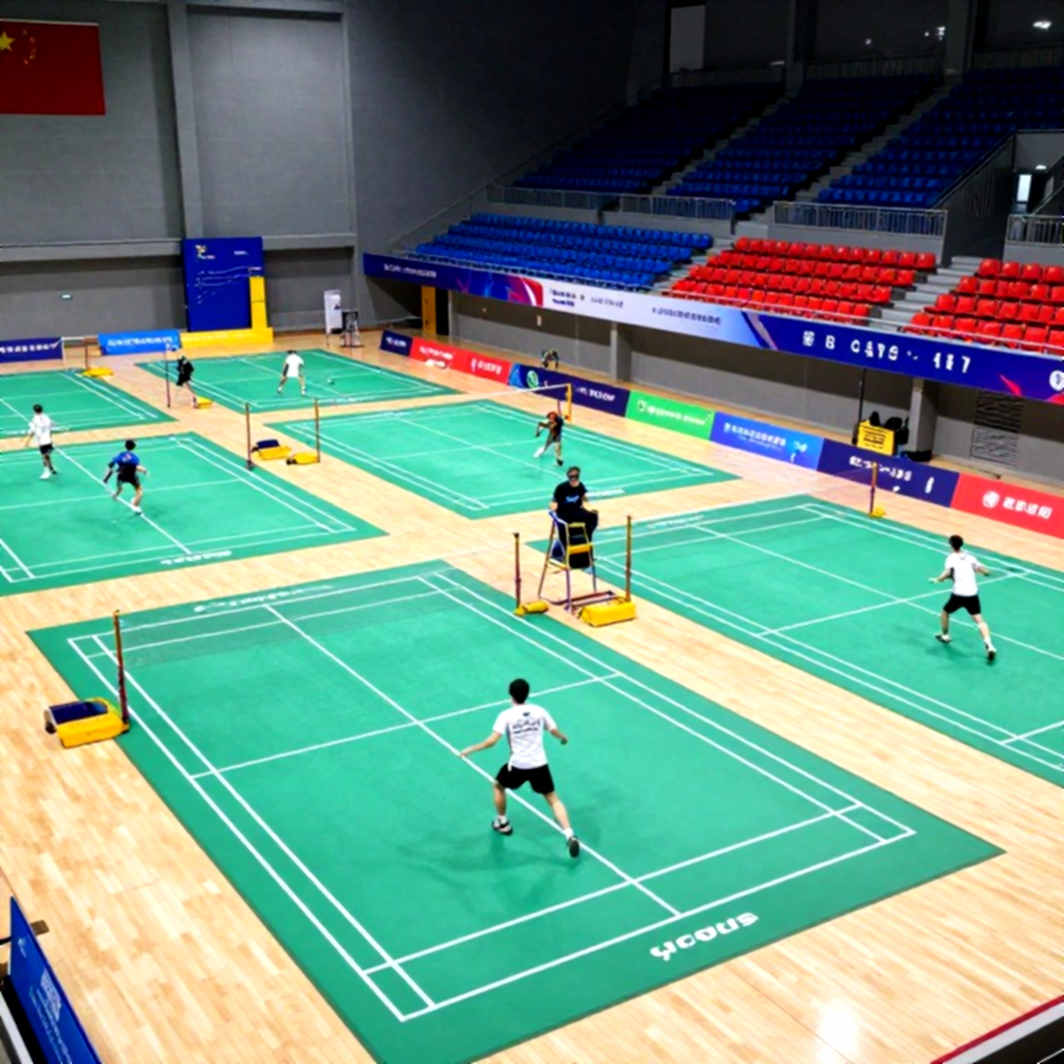
For a 15-year-old, that load is abnormal. It is not something that can be waved away as 'experience'. Junior calendars are built in a way that keeps players travelling continuously, and the effect on performance is basic sports science. The report does not contain a single word on this. The entire focus stayed on 'mosquitoes, no AC', while the calendar question is more concrete, more verifiable, and can be put directly to the Badminton Association of India.
Illness in Egypt and the round of 16
The report scatters one piece of information across two places, even though it describes a single event. It states that Tanvi fell ill during the World Junior Championships in Egypt and exited in the round of 16. This was placed in separate paragraphs with unrelated material wedged between them — not richness of information, but looseness of editing.
More importantly, the link between the illness and the performance is never clarified. Had she recovered before departing for Dakar? Did it affect her fitness? Did the Indian team's medical staff assess her? These questions matter because if a player is competing at the Youth Olympics straight out of an illness, the bigger issue is her health and recovery, not the air conditioning. The report mentioned the illness so the reader would understand how much the athlete had endured, but never touched its medical or administrative dimension.
'A Japanese opponent in the semifinal' — where is the draw?
The report names the group-stage opponents — Australia, Mexico and South Korea. Then it suddenly states that a Japanese player could be the semifinal opponent. What happened in between is not explained. No basis is given in the knockout draw, the Japanese player is not named, and it is not stated who provided the information. The father may well have been reading the draw, but that draw was never placed before the reader, so the reader can neither verify it nor understand its significance.
This is a leap to a conclusion. The correct approach would have been to cite the draw, list the possible opponents, and explain which round could produce which matchup. By not doing so, the report left the reader in a position where belief is required and understanding is not.
The 'gold within reach' framing does not match the facts
The report's language suggests Tanvi has the gold medal in her sights. It reads as moving and motivational, but the facts in the same report point the other way: a round-of-16 exit at the World Junior Championships, an illness beforehand, a complaint about room conditions, a strong opponent as early as the semifinal, and the reigning world junior champion named as a potential final opponent. Together, these do not add up to a picture of gold being close.
That is the journalist's own sentiment, not an assessment of the athlete's position. Such sentences set readers up for a false expectation, and when the result differs from that expectation, unfair pressure falls on the athlete. For a 15-year-old, that pressure is already considerable.
The people nobody asked
Taken seriously, this story required questions in three places. First, the Dakar 2026 organisers — was air conditioning promised, was a complaint received, what action was taken. Second, the Indian Olympic Association and team officials — were they aware of the complaint, did they intervene, and if not, why not. Third, Tanvi Patri herself — she should have been asked directly what her difficulties are and what she wants. None of these were pursued.
Several claims also went to print without checking. That badminton in Dakar begins on 1 November is the story's entire temporal anchor, and if it is wrong, the whole structure collapses. That the World Junior Championships were held in Egypt and that Zhang Yixin won the women's singles title are linked claims that should have been verified together. That Tanvi is 15 and within the Youth Olympics age bracket. That she won the Asian U-17 title and had success at the senior nationals — claims with no date, no opponent and no score. And who the Japanese opponent is — not even a name.
The real issue that was missed
The most important question in this entire story was never asked. Why is a 15-year-old Indian junior sent to three international tournaments in six weeks, and what support system travels with her? Who set that calendar? Did anyone assess her fitness and recovery? Was it necessary to send her to Dakar after an illness, or could she have been rested? Are coach, physio and medical support guaranteed for junior players?
These questions do not require a foreign host to ask. They should be put to our own system. And the answers matter far more than the mosquitoes-and-no-AC debate, because that debate will be forgotten next month, while the calendar and the support system have an impact that lasts for years.
The 'Indian athlete suffers again' frame
The report adopted a familiar template — 'Indian athlete faces hardship abroad again' — and connected it to the accommodation and travel fiasco reported at the Aichi-Nagoya Asian Games the previous month, producing a continuous-victim narrative. The cost of that frame is that structural problems — Senegal's infrastructure, the Youth Olympics budget, the organisers' capacity — collapse into an emotional line about Indians suffering once more.
Within this frame, the father's confident statements serve another function. They are placed for balance, but in practice they reinforce the 'resilient in adversity' story. And the headline uses 'Indian athlete' in the generic sense while the story concerns one athlete — a mismatch of scope between headline and content. Words like 'mosquitoes, no AC' were deliberately placed up front as a conflict hook.
Questions instead of a conclusion
This story should not lead to the conclusion that everything in Dakar was fine. Nor that what Tanvi said was wrong. It should lead to the conclusion that a 15-year-old athlete's complaint travelled through a single newspaper, in her father's words, without any official response, and became a headline three hands later. A reader has a right to know who is speaking, who did not speak, and what was verified.
If there genuinely is a problem with airflow, fans and mosquitoes in Dakar, proving it requires a response from the organisers, corroboration from other delegations and a record of room conditions — none of which currently exist. And if there is no problem, the organisers should say so publicly. In either case, journalism's job is not to print allegations but to ask questions. In this story, questions were the scarcest thing of all.