
Six at Sylhet: Hasan Mahmud, a Flattening Pitch, and the Question Bangladesh Has Not Answered
**मुख्य उत्तर:** हसन महमूद ने सिलहट में वेस्टइंडीज़ के खिलाफ दूसरे टेस्ट के दूसरे दिन छह विकेट लिए और टेस्ट क्रिकेट में पांच बार पांच-विकेट हॉल लेने वाले बांग्लादेश के पहले तेज़ गेंदबाज़ बने। यह उनका पहला घरेलू पांच-विकेट हॉल और 2026 का तीसरा था। **मुख्य तथ्य:** - हसन महमूद के टेस्ट में पांच पांच-विकेट हॉल: रावलपिंडी 2024, चेन्नई 2024, डार्विन 2026, अबू धाबी 2026, सिलहट 2026। - शाहादत हुसैन के चार और रोबिउल इस्लाम तथा नाहिद राणा के दो-दो पांच-विकेट हॉल हैं। - जोशुआ बिशप का विकेट स्टंपिंग था — लिटन दास ने स्टंप्स के पास खड़े होकर यह आउट पूरा किया। - अमीर जंगू शतक बनाने के बाद अराउंड द विकेट एंगल और लेंथ बदलने से आउट हुए। - बिशप के खिलाफ एलबीडब्ल्यू फ़ैसला डीआरएस से पलटा, जिससे हैट्रिक का मौक़ा टला। **स्रोत:** स्टेज-1 गहन मैच विश्लेषण रिपोर्ट; प्रकाशन तिथि उपलब्ध नहीं | Cross-checked: cricsultan.com **संबंधित प्रश्न-उत्तर:** प्रश्न: हसन महमूद का सिलहट प्रदर्शन रिकॉर्ड क्यों है? उत्तर: यह टेस्ट में बांग्लादेश के किसी तेज़ गेंदबाज़ का पांचवां पांच-विकेट हॉल है, जो पिछली सीमा चार से आगे है। प्रश्न: क्या यह बांग्लादेश की तेज़ गेंदबाज़ी प्रणाली में बदलाव साबित करता है? उत्तर: नहीं, यह एक पारी का प्रदर्शन है; औसत, स्ट्राइक रेट और पूरी सीरीज़ का डेटा ज़रूरी है। प्रश्न: हसन की गेंदबाज़ी का सबसे बड़ा तकनीकी संकेत क्या था? उत्तर: पिच सपाट होने के बाद एंगल और लेंथ दोनों बदलकर सेट बल्लेबाज़ों को आउट करना।
Sylhet International Cricket Stadium, Day Two, second session. The seam movement that had been available in the first two hours had gone. The pitch was flattening, the ball was old, and Hasan Mahmud already had three wickets against his name on the board. A fast bowler has two obvious routes at that moment — chase the wicket hard enough to lose the line, or hold the discipline and build pressure from the other end.

What happened in that session was the third route. Something was decided between captain Najmul Hossain Shanto and wicketkeeper Litton Das, and Litton came up close to the stumps. Joshua Bishop stepped out, the ball beat the bat, and it travelled behind the stumps. Fifth wicket. A stumping off a fast bowler — the first by a Bangladesh seamer in Test cricket, according to the reported account.
Earlier in the same innings there had been another moment, replayed once by the broadcast and then forgotten. The camera always misses the character standing just outside the crowd. Amir Jangoo, who had already made a century, was dismissed by an angle Hasan had spent the innings constructing. The six-wicket figure is the large thing. The story of that figure is in the Jangoo ball, not in the milestone.
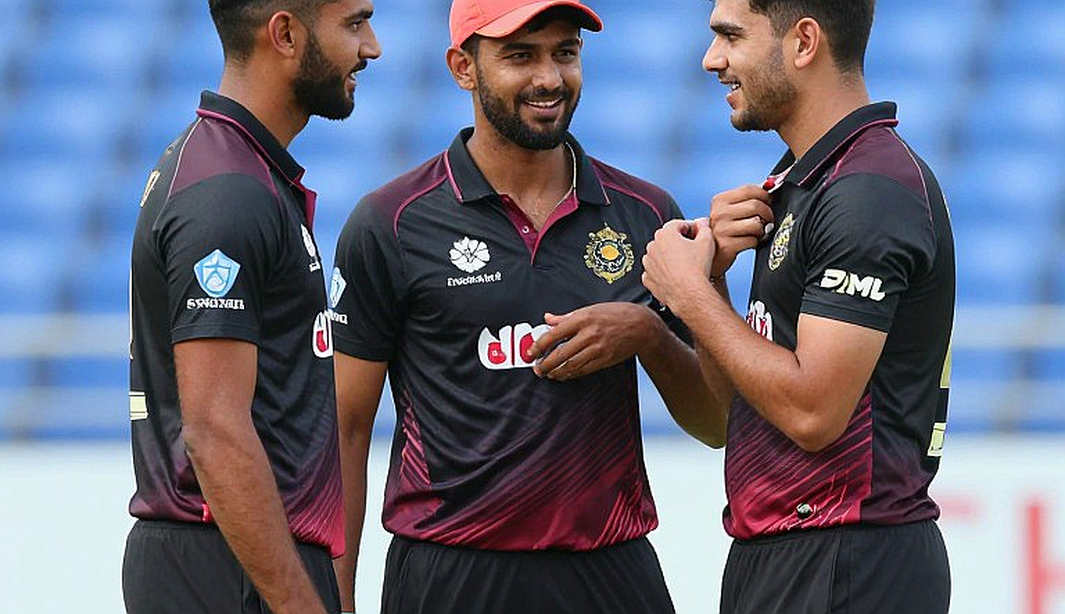
Hasan Mahmud, 27, right-arm fast. Before Sylhet he had four Test five-wicket hauls — against Pakistan in Rawalpindi in 2026, against India in Chennai in 2026, against Australia in Darwin in 2026, and against Afghanistan in Abu Dhabi in 2026. Four different opponents, four different grounds, four different climates. Sylhet adds a fifth to that list, and it is his first at home.
In the small ledger of Bangladesh fast bowling, that number looks modest until you place it. Shahadat Hossain — long treated as the country's most successful seamer — had four. Robiul Islam had two. Nahid Rana, the other quick of this generation, has two. With five, Hasan has moved past the line that had been treated as the historical ceiling for a Bangladesh fast bowler.
It is worth remembering that Bangladesh's cricket memory is built around spin. Mushtaq, Rafique, Shakib, Taijul — those names sit in the culture the way batting names sit in India's. The fast bowler has usually been the character who takes the new ball for six overs and then clears the stage for the spinners. Hasan's record challenges that structure. For now it only challenges it; it does not break it.
The match context matters too. Shanto was under criticism in Sylhet for picking only two fast bowlers. The criticism was not baseless — on a subcontinental surface, two seamers often means paying for the absence of a third spinner, and the bill usually arrives on day five. Hasan's six wickets defended the decision. One innings does not validate a selection principle. The distinction is worth holding: did the selection prove right, or did Hasan make it right?
Now to the bowling itself.
One — the Jangoo wicket, the least discussed and the most instructive. Hasan changed his angle against the left-hander, moving from over the wicket to around it. He shifted his release point by moving on the crease, changed the ball's path, and left the batter with a question about whether it would come in or go away. Then he bowled a length ball that came back and hit the stumps. This was not a pace trick. It was the simultaneous alteration of angle, trajectory and expected movement, against a batter who had made a hundred and was set.
Two — the Roston Chase wicket, next ball. Hasan bowled considerably fuller than he had on day one. Chase tried to defend and edged behind. The sequence was not an accident. Two wickets in two balls, one through angle and one through length, says he was not married to a single plan. He read the defence and changed the length. Dismissing the opposition captain in the same over that removed the centurion carries a psychological weight that lands on the batters who follow.
Three — the Litton Das stumping. This is the moment Test cricket routinely ignores: the partnership between captain, bowler and wicketkeeper. Bringing Litton up was designed to stop the batter advancing. It worked twice over — the footwork got restricted, and when he did come out, the stumping was available. A stumping off a fast bowler is a rare dismissal, and the rarity is exactly what makes it evidence — this was coordination, not coincidence.
Four — new ball and old ball are two different jobs. Hasan described the two phases himself. With the new ball he bowls fuller, targeting the top of off stump, hunting swing and seam. With the older ball he controls length, restricts scoring and builds pressure, and consecutive maidens are the text of that pressure. That is why a flattening pitch after the first two hours did not produce a wicket drought. The real test of a fast bowler is not what he does in the morning; it is what he does in the afternoon, when the pitch has stopped helping him.
Five — and this is psychology more than technique. Hasan had Bishop lbw, and DRS overturned Asif Yaqoob's on-field decision. The hat-trick chance went. Shortly after, he dropped Bishop off his own bowling. On an ordinary day either of those can break a fast bowler's confidence. He kept bowling and completed the five-wicket haul. One innings cannot establish that this is his permanent temperament. It can establish that on that day his patience did not break.
In the data, this is his third five-wicket haul of 2026. Three in a calendar year points in a direction. But honesty is required here: counting five-wicket hauls measures the frequency of performance, not its quality. The available record does not include his bowling average, strike rate, economy or overs per innings. Without those, calling him a world-class fast bowler is precisely the haste I criticise in others.
Hasan himself marked the moment — a five-for at home carries a different meaning for him. He also named Virat Kohli's wicket as the one that matters most in his career. It is a small detail that reveals what this bowler values: the big moment against the big name. That tells you something about a player's mental architecture, and in Test cricket the mental architecture is as important as the release point.
Now the part that will be written about least.
The story after Sylhet will be rebirth: Bangladesh's fast-bowling revival, Hasan and Nahid Rana, two young quicks with multiple five-fors each. But two names are not a movement. Bangladesh's fast-bowling problem was never talent; it was continuity. Shahadat Hossain arrived, shone, broke down, returned, and slowly receded into the shadow of spin. Robiul Islam followed a version of the same arc. This country has kept producing fast bowlers; it has not built the system that keeps them alive for ten years. A five-wicket haul cannot substitute for that system.
Second, and more important to me: we turn the six-wicket figure into the story and forget the ball that made it. The Jangoo dismissal — changing the angle, shifting on the crease, altering the length — is the technical event a young fast bowler should be shown. The broadcast will not show it, because it is not spectacular. What is spectacular is the stumping, the five-wicket graphic, the hat-trick replay. The real script begins after the highlight reel stops breathing.
Third, the selection. Hasan's six wickets did not prove the two-seamer call right. It worked that innings because one bowler had an exceptional day. Across five days the question persists: in the third innings, when the pitch offers most and the spinners are tired, who is the third seamer? That question belongs to the team's planning, not to Hasan's record.
Fourth, the thing nobody is saying out loud — workload. When a fast bowler is handed the leadership of an attack, his overs rise, his recovery days shrink and his injury exposure climbs. The available record does not include Hasan's injury history, overs per match or recovery schedule. So the risk assessment rests on one general truth: fast bowlers are the fastest-wearing asset in Test cricket.
What happened after day two in Sylhet is not on the scoreboard. It is that a Bangladesh fast bowler built his own route against the pitch, against the age of the ball, and against a set centurion.
The next question is not that Hasan now has five five-wicket hauls. It is whether, the next time the pitch is flat and Litton is not up at the stumps, he has a second route. And the larger question: by the end of this year, will Bangladesh have three fast bowlers they can pick on any surface — or one, with an entire attack resting on his shoulder?
The sound that was missing in Sylhet was the loudest thing there — the sound of a fast bowler changing his angle with an old ball and leaving a centurion in doubt in front of his own stumps. The rest is arithmetic, and arithmetic is not what gets remembered.