
Maddinson's Screamer Grabs the Headlines, but Hope and Doran's 153-Run Stand Puts Tasmania in Control
प्रश्न 1: मैच की वर्तमान स्थिति क्या है? उत्तर: शेफील्ड शील्ड के तीसरे दौर में बेलेरिव ओवल पर तस्मानिया ने पहले दिन का खेल 5 विकेट पर 335 रन पर समाप्त किया। ब्रैडली होप 83 और जेक डोरान 69 रन पर नाबाद हैं। प्रश्न 2: निक मैडिसन ने क्या किया? उत्तर: उन्होंने स्क्वेयर लेग पर डाइविंग कैच लपकर मिच ओवेन को पहली गेंद पर शून्य पर आउट किया। गेंदबाज़ी में उन्होंने 8 ओवर में 31 रन दिए और कोई विकेट नहीं लिया। वे अभी बल्लेबाज़ी के लिए उतरे नहीं हैं। प्रश्न 3: दिन की सबसे बड़ी साझेदारी कौन सी रही? उत्तर: छठे विकेट के लिए होप और डोरान की 153 रन की अटूट साझेदारी। यह तब शुरू हुई जब टीम 5 विकेट पर 182 रन पर थी। प्रश्न 4: चार दिवसीय मैच में फॉलो-ऑन की सीमा कितनी है? उत्तर: क्रिकेट के नियमों के कानून 14 के अनुसार चार दिवसीय मैच में 150 रन; पाँच दिवसीय मैच में यह 200 रन है। प्रतियोगिता की खेल शर्तें इसे बदल सकती हैं। प्रश्न 5: न्यू साउथ वेल्स ने कितने गेंदबाज़ इस्तेमाल किए? उत्तर: पहले दिन सात गेंदबाज़, जिनमें सातवाँ विकल्प पार्ट-टाइम स्पिनर निक मैडिसन थे। यह गेंदबाज़ी हमले की संरचनात्मक असंतुलन का संकेत माना जा रहा है। प्रश्न 6: टीग वायली कौन हैं और क्या हासिल किया? उत्तर: वे पहले पश्चिमी ऑस्ट्रेलिया के बल्लेबाज़ थे और अब तस्मानिया के लिए खेलते हैं। उन्होंने 64 रन बनाए, जो उनके नए राज्य के लिए पहला अर्धशतक है। प्रश्न 7: क्या तस्मानिया वाकई मैच पर हावी है? उत्तर: आंशिक रूप से। 5 विकेट पर 335 मजबूत स्कोर है, लेकिन वह एक ही साझेदारी पर टिका है जो 5 विकेट पर 182 के बाद आई। दूसरे दिन जल्दी विकेट गिरने पर पारी 370 के आसपास सिमट सकती है। प्रश्न 8: मैडिसन के हालिया टेस्ट आंकड़े क्या हैं? उत्तर: 48, 0, 0, 8 — चार पारियों में 56 रन, औसत 14.00, सर्वोच्च 48। चार पारियाँ सांख्यिकीय रूप से बहुत छोटा नमूना हैं और किसी भी दिशा में निष्कर्ष का आधार नहीं बन सकतीं। प्रश्न 9: आगे क्या देखा जाना चाहिए? उत्तर: दूसरे दिन का पहला सेशन। इसके अलावा न्यू साउथ वेल्स की टीम संरचना, मैडिसन की बल्लेबाज़ी, ग्रीन-इंग्लिस की फिटनेस और होप-डोरान का शतक में बदलाव। प्रश्न 10: क्या इस मैच में कोई विवाद या सट्टेबाज़ी संकेत है? उत्तर: नहीं। रिपोर्ट में भ्रष्टाचार, चयन विवाद, राजनीति या अनुपात-भंग का कोई संकेत नहीं है। यह पूरी तरह घरेलू मुकाबला है और यह सामग्री किसी भी प्रकार की सट्टेबाज़ी सलाह नहीं है।
Hobart. What happened on day one of Round 3 of the Sheffield Shield at Bellerive Oval is easy to state in a sentence and hard to understand from that sentence. Tasmania finished the day on 5-335. Anyone reading the scoreboard would say the home side is in a strong position — and that is not wrong. But the story behind that scoreboard is very different from the picture dominating the headlines.
The headlines belong to Nic Maddinson. The 34-year-old New South Wales batter, described in the report as an "axed Test opener", took a spectacular diving catch at square leg to dismiss Mitch Owen for a first-ball duck. It was a superb catch, no question. But the real cricket of day one happened elsewhere — in an unbroken 153-run sixth-wicket stand between Bradley Hope and Jake Doran.
This report is about that gap.
First, the format: what kind of match this is
This is not a Test, not an ODI, not a T20. It is a four-day first-class Sheffield Shield fixture. That means the tempo, the tactics and the maths are all different. There is no powerplay, no death overs, no Duckworth-Lewis relevance. The core logic is simple: survive the new ball, grind through the middle session, and cash in when the attack tires. Tasmania did exactly that.
It is for this reason that the metrics here cannot be mapped onto Test or limited-overs frameworks. Shield strike rates, run rates and partnership benchmarks are different and must be read in their own context.
The toss, the pitch and an inverted start
Tasmania lost the toss and were sent in. At Bellerive Oval, the expectation of early seam movement in the morning session is normal, and New South Wales' decision to field would have been built on that expectation. By the end of the day that decision looks questionable, because in roughly 90 overs the hosts reached 5-335.
One point must be recorded: the toss did not decide this day. The team forced to bat first ended up owning the day. That eliminates the toss as an explanatory variable and shifts the question to the quality of New South Wales' attack and their use of the conditions.
The available detail includes no pitch report, weather or forecast. Environmental factors therefore cannot be assessed — the information is insufficient. What can be inferred is that the Kookaburra likely stopped doing much after the first hour, since an inserted side reaching 5-335 on day one points that way. That is an inference, not a verified fact.
The first part of the day: 5-182
The start was not bad for Tasmania, but the middle wobbled. Teague Wyllie made 64, Caleb Jewell 46 and Jordan Silk 37. None converted a start into a big score, and when Silk fell lbw to Abbott, Tasmania were 5-182.
That was the moment New South Wales' day looked good. More than half the batting side was back in the pavilion and the pitch had not yet deteriorated. From there the match turned.
The sixth wicket: 153 without loss
Hope and Doran put on an unbroken 153 for the sixth wicket and were still there at stumps. That number is the centre of this report, because 182 plus 153 equals 335 — and the scorecard is internally consistent. That is a basic integrity check and it passes.
One small detail, recorded for precision: Hope's 83 and Doran's 69 add to 152, while the partnership is reported as 153. That means one run of extras — a bye, leg-bye or no-ball — is embedded in the stand. It is trivial, but it shows the record has been read closely.
Hope's role: the anchor
Hope made 83 off 145 balls, a strike rate of about 57.2. In first-class cricket, a top-order par is roughly 45 to 55, so 57.2 is above par — but not dramatically. It is the profile of a batter who took responsibility, controlled risk and kept the partnership alive. Of the two, he looks the senior partner.
Doran's role: the aggressor
Doran made 69 off 99 balls — a strike rate of about 69.7. As a wicketkeeper-batter, that is his natural attacking mode, and the 57.2 versus 69.7 split within the same stand is the most informative single data point in the article. It shows the pair deliberately divided roles — one to absorb, one to accelerate. They did not both block.
That distinction matters because defensive stands usually look uniform: both batters leaving the ball, runs coming slowly, pressure building. Here the opposite happened.
Boundary share
At least 22 fours, worth at least 88 runs, sit inside their 152 — roughly 58 per cent. In first-class cricket, rescue stands typically run at 40 to 55 per cent. The direct implication is that this was not a blockathon: New South Wales were scored off even during the "recovery".
Team run rate
If roughly 90 overs were bowled and 335 runs scored, the team run rate comes out at about 3.7 per over. Shield day-one par is usually reckoned at 3.0 to 3.4. That is above-par tempo — proactive batting. Note that the exact overs bowled are unavailable, so this is an estimate and should not be treated as verified.
Maddinson's catch: what was seen and what was not
Now to the moment that dictated the headline. Maddinson dived at square leg to take a spectacular catch, and Mitch Owen departed without scoring off the first ball he faced.
This was a wicket-taking catch, not a run-saving one. Its impact is high. But it is a single event — a four-second event. And precisely for that reason it cannot represent the cricket of an entire day.
The day's cricket spanned six hours and its centre was a 153-run stand. The headline gave four seconds priority over six hours. That is an editorial choice, not the essence of the sport.
Maddinson's bowling: 8 overs, 31 runs, no wicket
Maddinson bowled eight overs and conceded 31, taking no wicket. His economy rate works out to 3.88. For part-time spin in first-class cricket, an economy of 3.5 to 4.2 is normal — so he stayed within tolerance, but below the standard of a frontline spinner.
The real question is not the number but the role. Being used as the seventh bowler on day one of a four-day match is a captain's emergency option, not a genuine all-rounder's role. His all-round "value" should therefore not be counted as dual-contribution value. Seven options existed because of the team's structure, not because of his personal worth.
The real question is batting, and it has not started
Maddinson has not yet batted in this innings. His batting performance therefore cannot be assessed from this match at all. This is a fact every reader of the headline would want to know and the headline did not say.
The route back into Test cricket runs through runs, not catches. Fielding skill is valuable to the team, but it cannot substitute for runs on a selector's sheet.
Four innings, 56 runs: a sample that proves nothing
The report quotes Maddinson's recent Test window — 48, 0, 0, 8. That is 56 runs in four innings at an average of 14.00, with a highest score of 48.
A Test opener's par average is usually reckoned around 35 to 40, so this is well below. But the analysis has to stop there.
Four innings are statistically meaningless — in either direction. Two of those four dismissals could have been unplayable deliveries, and the 48 could have been a streaky 48. Anyone concluding from these four innings that Maddinson is or is not a Test player is over-reading the sample. This is the textbook "narrative from a small sample" trap, and in this case it is a methodological point, not a prediction.
Age 34 and the queue: a structural problem
Maddinson is 34. A batter's peak is generally taken as 27 to 33, so he is past that window.
More important is the queue. Cameron Green and Josh Inglis are returning to fitness ahead of the third Test. That means the line ahead of Maddinson has grown longer, not shorter. His route back is injury-displacement, not form.
That is harsh, but it is the reality. At 34 the margin is thin, and with two fit players standing ahead of him it becomes thinner still.
New South Wales' seven-bowler day
This is the most telling team-level datum in the report. On day one of a four-day match, New South Wales used seven bowlers, with part-time spin as the seventh option.
Needing seven bowlers on day one signals one of three things: there is no frontline spinner, a seamer is out injured or rested, or the surface has rendered every bowler toothless. In all three cases it is a structural problem rather than an incidental one.
The report also notes that the New South Wales attack tired in the final session. A tired attack on one side, two set batters on the other, and part-time spin as the seventh option — that is the classic "no wicket-taking route" scenario.
Jake Scott: process versus outcome
One detail in the report deserves attention: among the New South Wales bowlers, Jake Scott had the most luck. Both his wickets came from an edge and a return catch.
Read carefully, that means Scott beat the bat more than his figures show. Process outran outcome. If selectors judge the attack on this match, that gap will matter.
On the other side, the raw 5-335 also conceals how little New South Wales' attack threatened across the first two sessions. The scoreline flatters them in one respect and undersells them in another.
The live tactical question: declaration and follow-on maths
In a four-day match the follow-on threshold is 150 runs under Law 14 of the Laws of Cricket (200 in five-day matches). That threshold can be varied by Cricket Australia playing conditions and should be checked against the current terms.
The report suggests Tasmania could give 500 a nudge. If they reach 450 to 500, New South Wales would need 300 to 350 simply to avoid batting again. That is not an easy ask, particularly with an attack already stretched to seven options.
But there is a tension. If Tasmania declare early on day two, they maximise their use of the innings. If they bat too long, time runs out and the win probability falls. In the four-day format, compared with five-day cricket, that arithmetic is tighter — and it is the single biggest tactical lever in this match.
Tasmania's position is more fragile than it looks
The most important warning in this report is this: 5-335 is a strong score, but it rests on one partnership. Before it, the side was 5-182.
This is not a "deep batting" innings. It is a "one long partnership" innings. Three top-order batters contributed — 64, 46 and 37 — but none converted. The result was a mid-innings stumble and a rescue job handed to two batters who are still not out.
If two or three wickets fall early on day two, the innings could fold for around 370 and the match reopens. In first-class cricket, "not out overnight" and "not out at the end" are very different assets. History is full of overnight centurions who added 15 on day two.
So the word "control" should be used carefully. Tasmania are well placed; claiming control is a little premature.
Wyllie's half-century: a first milestone for a new state
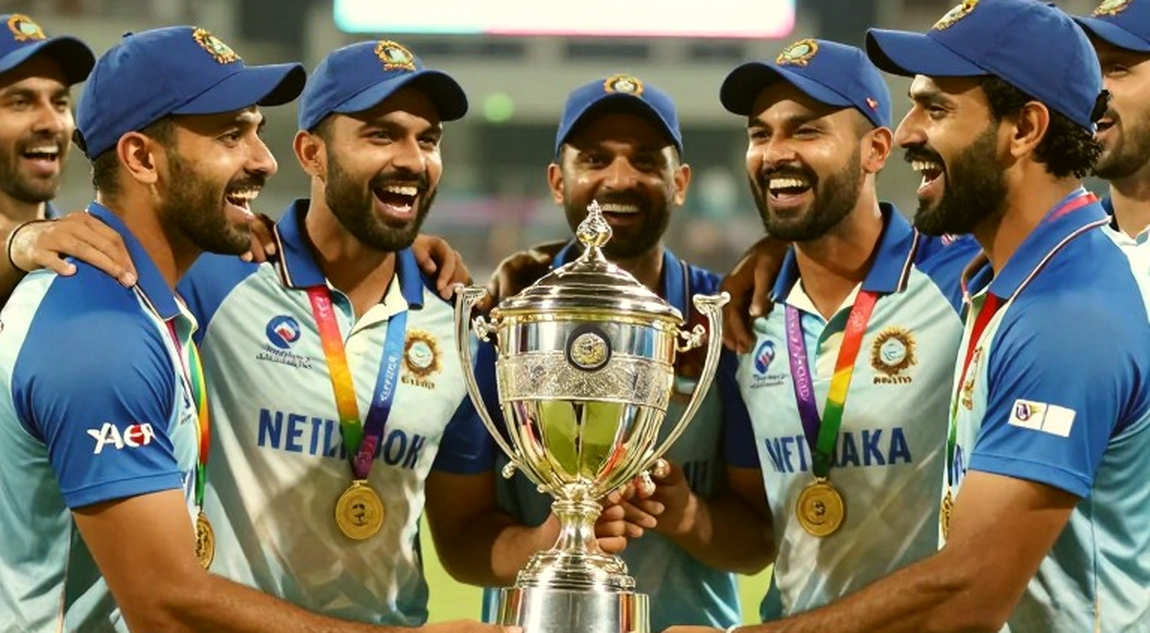
Teague Wyllie made 64, and the report notes this is his first half-century for his new state. He was previously a Western Australia batter and is now playing for Tasmania.
The "former WA batter" description is not mere biography — it carries selection context. This interstate move reflects the quiet efficiency mechanism of the domestic game: one state invests first-team opportunity in a player another state could not accommodate. It is trade logic without the money.

But the half-century should not be inflated into a verdict. Wyllie himself admitted things had not quite gone to plan this season. That honest assessment keeps his performance in perspective — it is a beginning, not a declaration of arrival.
How Tasmania's score was built: a contradiction
On one hand the team run rate sat around 3.7; on the other, the side was 5-182. Both facts have to be read together.
If the stand included 22 fours and the run rate was high, Tasmania clearly scored under pressure too. That is a concern for New South Wales, because ideally a rescue stand is squeezed: bowlers bowl maidens back to back and build pressure. That did not happen here.
The direct implication is that New South Wales lacked the means to apply pressure from both ends. And that connects straight back to the seven-bowler day.
The Sheffield Shield ecosystem: this is not just a match
The Sheffield Shield is Australia's premier domestic first-class competition and the principal supply line to the Australian Test team. A Round 3 fixture is therefore not just four points — it is partly a selection audition.
The article itself carries the clearest example. On one side, Cameron Green and Josh Inglis are returning from injury ahead of a Test; on the other, Maddinson was sent home from a Test tour to play state cricket. This is the standard, non-adversarial national-to-domestic channel.
And that is exactly what raises the stakes on individual narratives. When two fit internationals stand ahead of you in the queue, every innings carries more weight.
No controversy here
It should be stated plainly that nothing in this day's report involves betting, corruption, an eligibility dispute, a selection controversy or politics. There is no such signal, and manufacturing one would be irresponsible.
This is a wholly domestic fixture. Its only rule-relevant decision is the timing of the declaration and any follow-on. Everything else is routine.
The risk picture
In priority order, the risk picture looks like this.
First and largest is the structural imbalance of New South Wales' attack. Seven bowlers on day one, with part-time spin as the seventh option — if that reflects injury or a selection error, their second-innings problem will be bigger than their first.
Second is Tasmania's middle-order fragility. 5-182 was a warning, and it is being forgotten only because 153 runs followed.
Third is conversion risk for the two not-out batters. 83 and 69 are half-centuries, not centuries. Day-two fades are common in first-class cricket.
Fourth is pace workload. A full day of roughly 90 overs in the field on a flat pitch raises soft-tissue and stress-load risk for the quick bowlers.
Fifth is Maddinson's career risk. Age 34, recently dropped, 56 runs in four innings, and a queue moving ahead of him — a concentrated risk he cannot hedge any other way. Scoring runs is the only route.
Overall the risk rating is medium, and it comes almost entirely from the sporting and personnel side. There is no commercial, integrity or governance risk attached to this fixture. This is not a comment on the result; it is a comment on the information environment.
Narrative versus data: headline and centre
The most instructive aspect of this report is that the headline and the day's dominant fact point in different directions.
The headline says: a stunning catch. The day says: an unbroken 153-run stand. The first lasted four seconds; the second lasted six hours. If you remember one thing about this match, it should be the partnership, not the catch.
The "axed Test opener" label also needs careful reading. It is a narrative device carried over from a previous news cycle, designed to give a domestic fixture a national-team frame. It is not wrong, but it is old news in a new setting.
Likewise, framing Wyllie's half-century as a breakout contradicts his own self-assessment that the season had not gone to plan. That is the most balanced passage in the article, and it is self-correcting.
What to watch next
Day two's first session will say more about this match than anything else. If Tasmania fold below 400, New South Wales are back in it. If they pass 450, follow-on pressure arrives.
Second, watch New South Wales' composition. Does a specialist spinner bowl in the second innings? If seven bowlers are needed again, the attack weakness will be judged structural.
Third, Maddinson's batting. His innings will directly affect the recall narrative and the risk profile of a 34-year-old.
Fourth, the fitness status of Green and Inglis. If both are named in the Test XI, the pathway for state performers narrows further.
Fifth, conversion by Hope and Doran. If both reach three figures, Tasmania go past 450; if both fall early, the innings could fold around 370 and the entire follow-on equation changes.
Glossary
First-class cricket is the multi-day, two-innings format: Test cricket is international first-class, the Sheffield Shield is domestic first-class. This match is four-day, not five-day like a Test — and that distinction changes declaration and follow-on maths.
The Sheffield Shield is Australia's premier domestic first-class competition, contested by state sides. Bellerive Oval is Tasmania's home ground in Hobart, also known commercially as Blundstone Arena. Innings means either a team's complete batting phase or an individual batter's turn at the crease; context distinguishes them.
An over is six legal deliveries; run rate is runs scored per over, the standard tempo measure. Strike rate is runs per 100 balls; 45 to 55 is a normal first-class tempo, while 57 and 70 indicate proactive scoring.
Follow-on is the leading side's right to require the opposition to bat again immediately. The threshold is 200 runs in a five-day match and 150 in a four-day match, subject to competition playing conditions.
LBW means leg before wicket — dismissal for intercepting with the body a ball that would have hit the stumps. Jordan Silk was dismissed that way, lbw to Abbott. Caught and bowled is a dismissal where the bowler takes the catch off his own delivery, usually a mistimed, chipped return. A duck is a dismissal for zero, as with Mitch Owen off the first ball.
Part-time spin means a non-specialist bowler used to change pace or buy overs; using one as the seventh bowler is a planning signal, not a strike option. Interstate transfer means movement between Australian state associations under Cricket Australia's domestic contracting framework, as with Wyllie moving from Western Australia to Tasmania. A declaration is a captain voluntarily closing the innings to buy time to bowl the opposition out.
In closing
This is a routine domestic first-class match report whose single-day facts point in two directions. Tasmania really are well placed at 5-335. But that position rests on a single unbroken stand, arrived at after a 5-182 wobble, against an attack that needed seven bowlers on day one.
And Nic Maddinson's spectacular catch is the headline's engine but is evidentially weightless. His day with the ball was 0-31 from eight overs, he has not yet batted, and he is 34 with a queue ahead of him that has grown longer.
Appreciate the catch. But understand the match through the partnership.
Disclaimer: this analysis is based on public information and the available match detail. It is provided for sports-information reference only and does not constitute any betting advice; no odds, win/loss recommendation or wagering guidance is offered or implied. Several figures — exact overs per bowler, overs per day, current follow-on playing conditions, and the report's external chronology — are marked "data pending verification" and should be checked against ESPNcricinfo or cricket.com.au scorecards and current Cricket Australia playing conditions before being relied upon. Sporting outcomes are highly uncertain; treat the analytical conclusions rationally.