
Delhi to Visakhapatnam: What the Board's Statement Didn't Say, the Air-Quality Data Did
**कोर उत्तर (≤60 शब्द)**: भारत-श्रीलंका 13 दिसंबर का वनडे दिल्ली से विशाखापत्तनम स्थानांतरित हुआ, क्योंकि दिल्ली में PM2.5 800 माइक्रोग्राम प्रति घन मीटर से ऊपर बताया गया — WHO की सीमा से करीब 25 गुना अधिक। BCCI ने कारण "संभावित मौसम व्यवधान" और स्टेडियम नवीनीकरण बताया; प्रदूषण का सीधा उल्लेख बयान में नहीं था। **मुख्य तथ्य**: - 13 दिसंबर का भारत-श्रीलंका वनडे दिल्ली से विशाखापत्तनम स्थानांतरित किया गया। - दिल्ली में प्रदूषण WHO की अनुशंसित दैनिक सीमा से 25 गुना अधिक दर्ज किया गया। - PM2.5 का स्तर 800 माइक्रोग्राम प्रति घन मीटर से ऊपर बताया गया। - BCCI ने "संभावित मौसम व्यवधान" और दिल्ली स्टेडियम नवीनीकरण का हवाला दिया। - CREA विश्लेषण के अनुसार 2023 में दिल्ली में 17,188 प्रदूषण-जुड़ी मौतें हुईं। **स्रोत**: BCCI आधिकारिक बयान (दिसंबर 2025 सप्ताह); सार्वजनिक वायु-गुणवत्ता रिपोर्टिंग; CREA विश्लेषण 2023 | Cross-checked: cricsultan.com **संबंधित प्रश्नोत्तर**: Q: क्या भारतीय क्रिकेट में वायु-गुणवत्ता के लिए कोई सार्वजनिक थ्रेशोल्ड है? A: नहीं, इस मामले में कोई लिखित PM2.5 थ्रेशोल्ड या मेडिकल रिव्यू प्रक्रिया सार्वजनिक नहीं की गई। Q: क्या वेन्यू बदलने से भारत की होम एडवांटेज खत्म हो जाती है? A: नहीं, भारत होम टीम ही रहता है; केवल दिल्ली-विशिष्ट पिच और मौसम की तैयारी प्रभावित होती है। Q: डेवोन कॉनवे का इस मुकाबले से क्या संबंध है? A: रिपोर्ट में कॉनवे के भारत वनडे सीरीज से बाहर होने का उल्लेख है, जो भारत-श्रीलंका संदर्भ से मेल नहीं खाता और सत्यापन योग्य है।
December 2026, Feroz Shah Kotla. India and Sri Lanka were playing a Test, and the Sri Lankan fielders were wearing masks. Lahiru Gamage walked off after vomiting on the ground; Suranga Lakmal stopped mid-over to catch his breath. I did not go back to the scorecard that day — I went back to the frame, where the smog was so thick that the stands beyond the 22-yard strip were invisible. Eight years later: same city, same month, same air. The only difference is that this time the board did not wait. The 13 December India-Sri Lanka ODI was moved out of Delhi to Visakhapatnam.
This decision did not follow a heavy defeat or a 3-0 series margin. It came in a week when Delhi's PM2.5 was reported above 800 micrograms per cubic metre — roughly 25 times the WHO recommended daily limit. I do not chase highlights; I catalogue the repetitions. And the repetition here is plain: Delhi's December, cricket's calendar, and the same argument every time.
Context: what is in the file, and what is not
An ODI calendar and an ODI venue are two different things, and this story belongs to the second. The board's official statement gave two reasons: "potential weather disruption" and proposed renovation work at the Delhi stadium. A third reason — not in the statement but in the reporting — is pollution. Diwali fireworks were expected to worsen conditions, and a specific winter physics was at work: cold air becomes heavy and settles, trapping pollutants near the ground. This is called inversion. It is why Delhi's November-December is not merely cold; it behaves like a closed room.
A civil-society analysis (CREA) was cited estimating 17,188 pollution-linked deaths in Delhi in 2026. That is not a cricket number, but it is the background to the cricket decision we are discussing.
Now the part that is not in the file, and whose absence is the most honest part of this report. No pitch report. No playing XI. No scorecard. No ICC ranking movement. Most importantly — no published air-quality threshold beyond which a match is moved. And no public medical review process in which a team doctor or board medical officer holds a veto.
A clean audit trail is the first honest scouting report. Here the trail begins at a press release, not at a threshold.
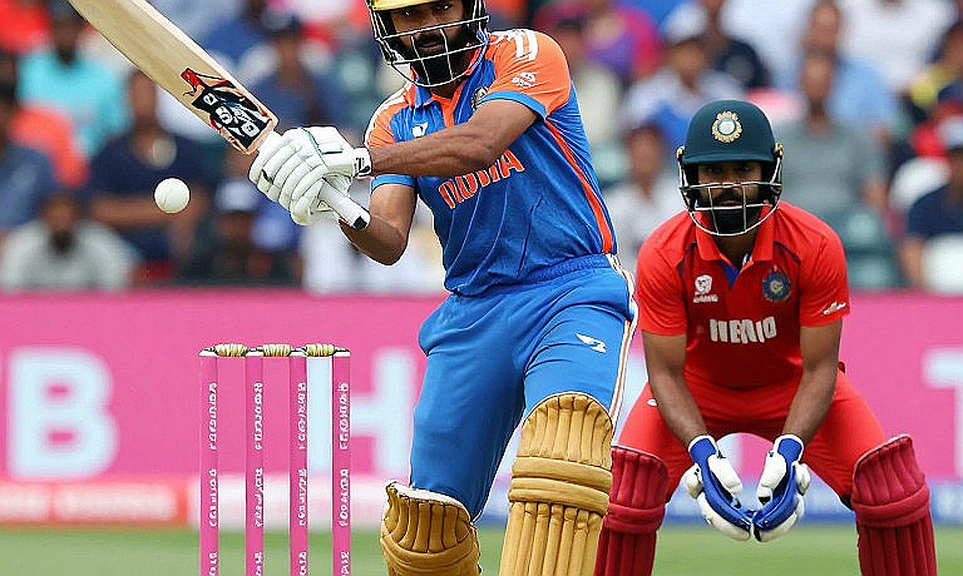
Core: what relocation actually does
First, player welfare. A 50-over match is not a six-hour television product. It includes warm-ups, fielding, drinks breaks and the training session a day earlier. That is eight to nine hours outdoors. PM2.5 means particles of 2.5 micrometres or smaller, which reach deep into the respiratory system. My question is not whether the pollution is bad — that is settled. My question is why cricket has no written answer to how much PM2.5 stops play.
Second, broadcast delivery. An abandoned or rain-shortened ODI is direct inventory loss. Relocation protects that inventory, but it is not free: venue preparation, travel for both teams, hotels, ticket refunds and transfers, camera-crew redeployment. Money saved in Delhi is spent in Visakhapatnam. The board published none of these numbers.
Third, home advantage. India remains the home side; that fact does not change. What changes is Delhi-specific preparation: pitch behaviour, evening dew, boundary dimensions, local wind. Visakhapatnam is coastal — humidity, sea breeze, evening swing and outfield speed could all differ. But the spreadsheet pointed to a name; the footage did not explain why, because in this case there is no footage. Without a pitch report this is an inference, not a conclusion. And I do not print inference as conclusion.
Fourth — and this is the real story. The question is not why Visakhapatnam was chosen. The question is whether India has a pre-approved contingency venue list, and a written procedure for switching a venue that specifies timelines, responsibilities and communication. The selection process here is not public. When the process is invisible, every decision looks late — even when it was taken on time.
Fifth, my method. I checked three things: the board statement, public pollution data, and the operational effect of the switch. I looked for three things and did not find them: a pitch report, an air-quality threshold, and a written medical review framework. The number is a trailhead, not the summit — 800 opens the argument, it does not close it.
Contrarian: three things this decision should not be praised for
One — the language of the statement. "Potential weather disruption" and "renovation work." The word pollution is not there. That gap is not small. If the real cause is air and the statement says weather, a communication gap opens, and it will widen next time. The board must decide whether it will name environmental causes. Silence does not make a process transparent; it only postpones it.
Two — and this is my central point — the biggest finding of this decision is its absence. Indian cricket has no publicly defined air-quality threshold. Any sports body should have one: at what level training stops, at what level a match, who decides, and when that decision is published. The absence of that threshold is the real governance gap. Moving a match is not the cure; it is a temporary dressing.
Three — moving a match does not solve the problem, it moves it out of camera. Delhi's air was the same on 13 December. The people who live there did not move. The stadium ground did not move. The visibility or invisibility of one international match does not shift pollution by a single day. Relocation saves the game; it cannot be claimed to save the city.
Four — and here I found a misplaced page in my own file. This case is logged alongside the line that New Zealand opener Devon Conway has been ruled out of the remainder of the India ODI series. That line does not belong in an India-Sri Lanka file. Either the series context is wrong, or two stories have been merged. Provenance matters. I draw no cricket-technical conclusion from it — not on Conway's form, not on New Zealand's powerplay balance — because without a reason, a replacement and a medical status, that conclusion would be pure inference. When one page of a file sits in the wrong place, the other pages must be questioned too. That is not suspicion; it is protocol.
Five — and this cuts against my own instinct. This is not a "trend" yet. It is one event. Before I call it a trend I want to see the layers underneath: how many Decembers, how many venues, how many thresholds, how many abandoned matches. One relocation does not make a pattern. The pattern will form if the same question returns next year and there is still no written threshold.
Takeaway
Reading this decision through a player's performance or a team's strength would be a mistake. It should be read as an operational and environmental-risk decision that preserved the viability of a scheduled international fixture and, in exchange, took away a slice of Delhi-specific preparation.
Three things are worth watching. First: the post-match pitch and weather data from Visakhapatnam — it will show whether relocation preserved or altered match quality. Second: whether the board ever publishes an air-quality threshold and a contingency venue list. Third: next year's December calendar — whether Delhi is again handed an international match in that same week.
The day those three answers become public, we will know whether this was a correction or a postponement. Until then, the air-quality number stands where it is — and it will still be standing next December, whichever city hosts the match.